Skip to content


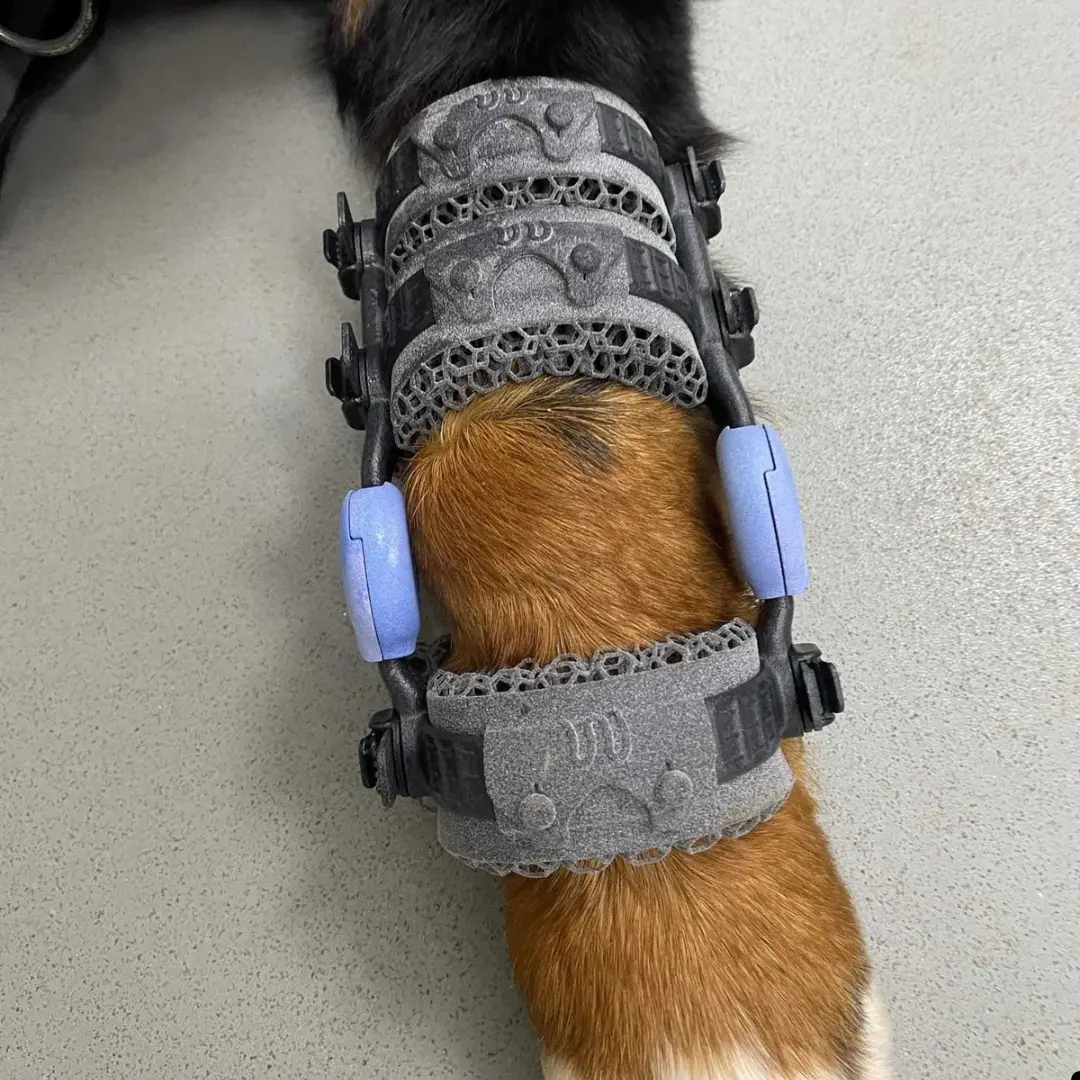
Remote dog orthotic fitting can streamline how patient data reaches the manufacturer, but it does not turn a custom orthosis into a direct-to-owner product. For eligible WIMBA Carpus Orthosis GO and Tarsus Orthosis GO cases, a veterinary provider submits two weight-bearing photographs and product-specific manual measurements through WimbaAPP. A dog brace fitting from photos still requires diagnosis, correct data capture, professional fitting, and follow-up.
The word “remote” describes the digital transfer of information, not the removal of clinical responsibility. GO and PRO follow different data pathways, while WIMBA Cervical Collar GO follows a separate sizing process. This guide explains how remote dog orthotic fitting separates digital data capture from the clinical steps that must remain in the clinic, and how responsible veterinary orthotic fitting connects assessment, ordering, application, and reassessment.
What Remote Dog Orthotic Fitting Actually Means
In remote dog orthotic fitting, digital data capture can replace casting in current WIMBA limb pathways, but it cannot establish a diagnosis or decide whether external support is appropriate. Good veterinary orthotic fitting begins with the treating professional identifying the affected structure, direction of instability, required motion control, and functional goal before selecting a product pathway.
After the data are submitted, WIMBA uses them for product selection or patient-specific design, depending on the device. A safe remote dog orthotic fitting workflow keeps clinical responsibility with the clinic, including the accuracy of the submission, the prescription, the first fitting, owner education, and follow-up.[1] Pet owners can help with calm handling and home monitoring, but they do not independently measure, prescribe, configure, or order WIMBA devices.
The Three Current WIMBA Data Pathways
Remote dog orthotic fitting does not use one universal photo, measurement, or scanning checklist for every WIMBA product. A dog brace fitting from photos belongs only to the appropriate GO limb pathway, and WIMBA GO measurements vary by product. The provider should select the device first, then follow the current instructions shown for that exact product in WimbaAPP.
| Pathway | Patient data | Important distinction |
|---|---|---|
| Carpus Orthosis GO and Tarsus Orthosis GO | Two required weight-bearing photographs and current product-specific manual measurements | No WimbaSCAN. Intended only for eligible cases within current GO indications |
| Carpal, tarsal, and stifle PRO devices | WimbaSCAN, specified manual measurements, clinical information, and required supporting media | Scan-based pathway completed by an appropriately equipped Provider PRO |
| WIMBA Cervical Collar GO | Three soft-tape patient measurements | The closest of five predefined adjustable sizes is suggested. This is not a custom limb scan |
Convenience should not determine candidacy. The suitability of remote dog orthotic fitting depends on whether the diagnosis, limb geometry, direction and severity of instability, and intended mechanical goal match the current product criteria.
How WIMBA GO Measurements Work
Within remote dog orthotic fitting, WIMBA GO measurements are collected by the veterinary provider using the current product-specific instructions. Carpus Orthosis GO and Tarsus Orthosis GO each require two clear weight-bearing photographs and the manual measurements requested for that device. No WimbaSCAN is required.[1][2]
For remote dog orthotic fitting to work reliably, the photographs cannot be casual owner snapshots. A dog brace fitting from photos requires correct position, camera angle, full limb visibility, weight bearing, scale, and image clarity. Accurate WIMBA GO measurements must be taken at the specified anatomical locations with the patient positioned as instructed. The carpal and tarsal measurement sets should not be assumed to be identical.
A dog brace fitting from photos is therefore better described as a photograph-and-measurement pathway. The images provide visual information while the manual values provide dimensions. Clinical information explains what the orthosis needs to control. Missing or inconsistent data may require correction before design and production can begin.
GO is intended for eligible cases within current indications. A mild, mainly sagittal-plane presentation may be suitable, while severe deformity, complex paw involvement, marked rotational or frontal-plane instability, or an unclear diagnosis may require a different pathway. When the case does not clearly fit, use a WIMBA case consultation before collecting final order data.
When WimbaSCAN for Dog Orthoses Is Required
Remote dog orthotic fitting through the PRO pathway uses WimbaSCAN for dog orthoses when the selected carpal, tarsal, or stifle device requires scan-derived three-dimensional limb geometry. The veterinary team also submits the specified manual measurements, clinical information, and supporting media requested for that product. A scan does not replace the rest of the case record.[2]
An appropriately onboarded and equipped Provider PRO captures the scan. Collecting WimbaSCAN for dog orthoses requires correct patient positioning, lighting, scan path, movement control, and visibility of the patterned surface. If the dog cannot be positioned safely or consistently, the team should pause and discuss the case instead of submitting a compromised scan.
WimbaAPP, WimbaSCAN, and WimbaBOX are related but different parts of the workflow. WimbaAPP is used to submit and manage the order. WimbaSCAN is the data-capture method. The equipment supporting WimbaSCAN for dog orthoses is WimbaBOX, a kit with tools such as a calibration mat, AutoDolly, and patterned sleeves.[3] WimbaBOX is not an alternative measurement method.
Why the Cervical Collar Uses a Separate Process
WIMBA Cervical Collar GO is not ordered through either limb workflow. The provider takes three patient measurements with a soft measuring tape and enters them in WimbaAPP. The app suggests the closest of five predefined sizes: Nano, XXS Short, XXS, XS, and S. The professional reviews that recommendation, confirms the size, and adjusts the collar at the neck and chest during fitting.[4]
No WimbaSCAN or WimbaBOX is required for the collar. The collar shows why remote dog orthotic fitting must be understood as a product-specific process, not one measurement method for every device. It is an adjustable size-selection pathway, not a patient-specific limb model. Diagnosis, neurological assessment, product candidacy, final sizing, fitting, monitoring, and the decision between conservative and surgical management remain clinical responsibilities.
What Must Always Stay With the Clinic
- Diagnosis and candidacy. The treating team identifies the condition, rules out problems that need another treatment, and decides whether an orthosis has a defined role.
- Mechanical prescription. The team states which joint and movement require control, what range should be allowed, and what outcome will be reviewed.
- Accurate data capture. Staff collect photographs, measurements, clinical information, and scan data exactly as the selected product requires.
- First fitting. The clinic checks joint alignment, frame position, strap tension, rotation, clearance, pressure, and gait before home use begins.
- Owner education. The owner learns correct application, removal, skin checks, cleaning, permitted activity, and the prescribed wear schedule.
- Follow-up. The team reassesses fit, gait, skin, patient acceptance, joint control, and the original functional goal.
This is why remote dog orthotic fitting and veterinary orthotic fitting cannot be reduced to uploading files. A technically complete order can still be clinically unsuitable, while a well-selected device can perform poorly if it is misaligned, introduced too quickly, or left unreviewed as the patient changes.
First Fitting and Follow-Up Cannot Be Remote by Default
Remote dog orthotic fitting does not make the first fitting remote by default. A veterinary orthotic fitting appointment must show how the finished device behaves through stance, stride, turning, sitting, and rising, which a static photograph cannot demonstrate. The provider uses hands-on examination and controlled movement to compare device position and gait with the intended joint axis and the patient’s baseline.
Video can support later communication, especially when a problem appears only at home, but it does not automatically replace a recheck. Persistent redness, abrasion, swelling, pain, worsening lameness, rotation, repeated hard-component contact, or reluctance to move should prompt device removal and contact with the clinic. Structural parts and motion-control components should not be altered at home.
Growth, swelling, weight change, muscle loss or gain, surgery, disease progression, and a changed limb position can make earlier data outdated. Stored photos or scans may help with review, but the clinic must decide whether new measurements, new images, another scan, adjustment, or replacement is needed.[5]
When the Photo-Based Route Is Not Enough
Remote dog orthotic fitting should stop when the available pathway cannot describe the clinical problem accurately. Do not force a patient into GO because it is faster or requires less equipment. Request further assessment or a case consultation when the diagnosis is uncertain, the instability is outside current GO indications, several planes of movement are involved, the paw must be incorporated, limb geometry is complex, or the photographs and measurements do not describe the problem consistently.
A case consultation can help determine whether the clinic should collect GO data, arrange a PRO scan, obtain additional imaging, refer the patient, or choose another treatment. It does not replace the treating professional’s diagnosis or prescription.
A Submission Checklist for Veterinary Teams
- Is the diagnosis established and is external support part of the treatment plan?
- Which joint, plane of motion, and structure require protection or control?
- Does the case match current GO indications, or does it need the PRO pathway or further review?
- Were photographs, measurements, clinical details, and scan data collected using the current instructions for that exact product?
- Are swelling, wounds, coat, positioning, or patient movement likely to make the data unreliable?
- Who will perform the first fitting and owner training?
- What outcome will be assessed, and when is the first recheck?
For the broader production and rehabilitation workflow, read digital dog brace fitting. Clinics can also review WimbaAPP for veterinary clinics, introducing orthotic fittings in a veterinary practice, and how to become a WIMBA Provider. Together, these resources place remote dog orthotic fitting within the full clinical and operational workflow.
Choose the Pathway Before Collecting the Data
Successful remote dog orthotic fitting follows a clear sequence: diagnosis, mechanical goal, product pathway, correct data capture, professional fitting, and scheduled reassessment. The result of veterinary orthotic fitting depends on every stage, not only on the files submitted. Veterinary teams can begin an eligible GO order in WimbaAPP or ask WIMBA to review a case before choosing between GO, PRO, or another treatment route.
Verified veterinary professionals can download WimbaAPP from the Apple App Store or Google Play, then create their clinic account directly in the app.
Frequently Asked Questions About Remote Dog Orthotic Fitting
These answers summarize the current workflow. The treating professional and the latest product instructions determine what is appropriate for an individual patient.
Can I order a custom dog orthosis myself using phone pictures?
No. WIMBA devices are ordered through veterinary professionals. The treating provider establishes the clinical need and submits the required photographs, measurements, scan data, and case information for the selected product.
Is dog brace fitting from photos possible without measurements?
No. Eligible GO limb orders use two required weight-bearing photographs together with the current product-specific manual measurements and relevant case information. Photographs alone are not a complete submission.
Does every WIMBA GO product use the same measurement checklist?
No. WIMBA GO measurements depend on the selected product. Carpus and Tarsus GO use two photographs plus their own manual measurement sets, while Cervical Collar GO uses three measurements to select from five predefined sizes.
Do all WIMBA PRO limb devices require a scan?
Yes. The current carpal, tarsal, and stifle PRO pathways use WimbaSCAN for dog orthoses together with specified manual measurements, clinical information, and any required supporting media.
Is WIMBA Cervical Collar GO made from a 3D limb scan?
No. It is an adjustable cervical orthosis available in five predefined sizes. A veterinary professional enters three patient measurements in WimbaAPP, reviews the suggested size, and checks the final fit.
Can the first fitting be completed only by video call?
A video can provide useful supplementary information, but the treating clinic remains responsible for a hands-on first fitting, gait assessment, owner instruction, and the wear plan. It should not assume that a static remote view is sufficient.
What should a clinic do when the correct pathway is unclear?
Submit the diagnosis, clinical history, relevant imaging or photographs, and intended mechanical goal through a WIMBA case consultation. The review can help determine whether GO, PRO, further assessment, referral, or another treatment route is more appropriate.
Medical Disclaimer: This article is intended for general educational purposes only and is not a substitute for veterinary examination, diagnosis, prescription, fitting, device-specific instructions, or follow-up. Do not select, measure, scan, fit, modify, or progress an orthosis without direction from the treating veterinary or rehabilitation professional.
Product and Workflow References
- WIMBA. WimbaAPP for Veterinary Clinics: Start With Orthotics. Current GO and PRO ordering workflows.
- WIMBA. Digital Dog Brace Fitting: Measurement to Rehab. Product-specific data capture and fitting workflow.
- WIMBA. Become a WIMBA Provider. WimbaSCAN and WimbaBOX overview.
- WIMBA. WIMBA Cervical Collar GO. Sizing, fitting, and ordering information.
- WIMBA. How to Order WIMBA Devices for Your Pet. Current patient and clinic ordering guidance.