 Skip to content

A veterinarian may recommend a carpal orthotic for dogs when examination identifies a specific mechanical problem at the wrist that external support can address. Front-limb lameness alone is not enough. The decision depends on the diagnosis, joint level, direction and severity of instability, pain, skin health, activity, and the functional goal.
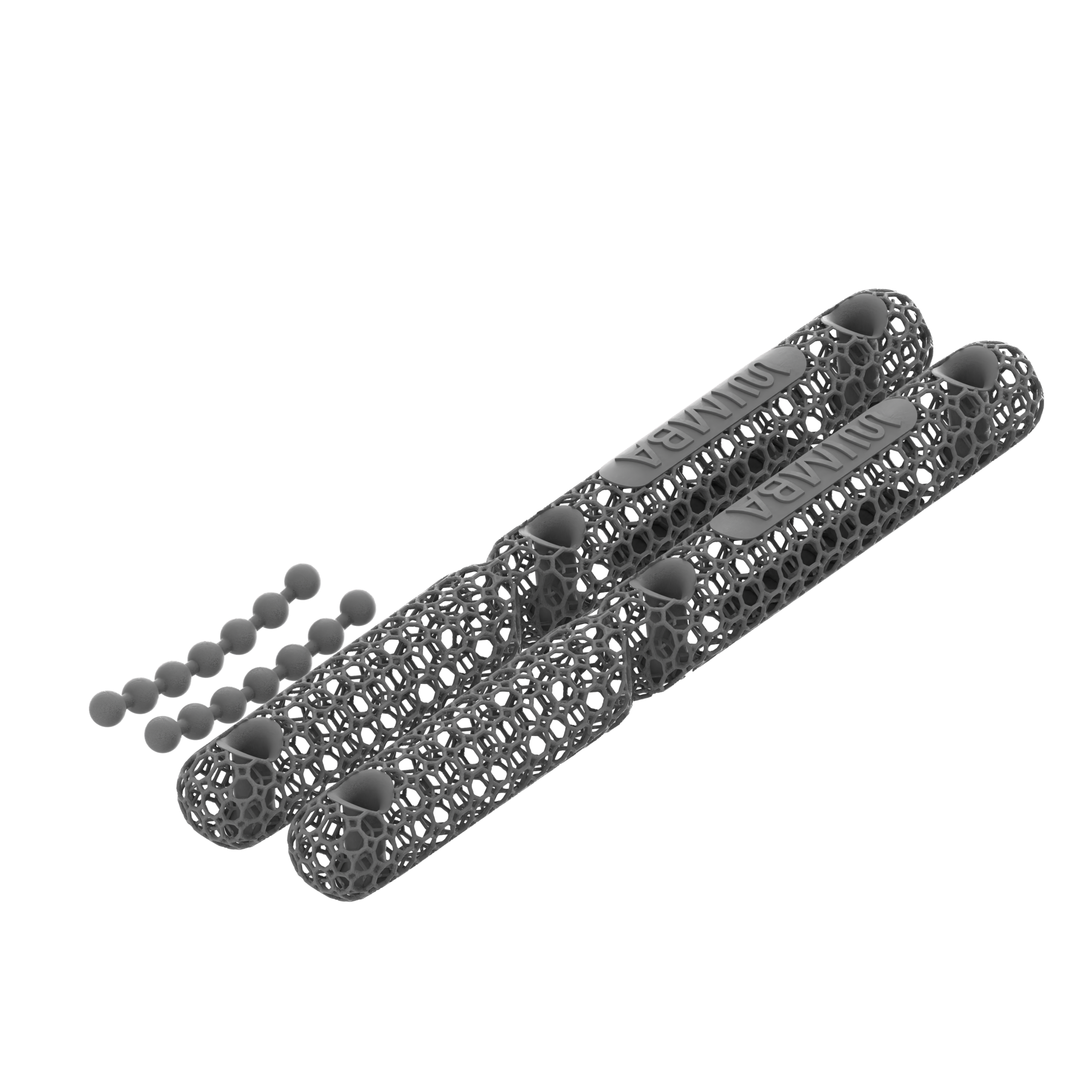
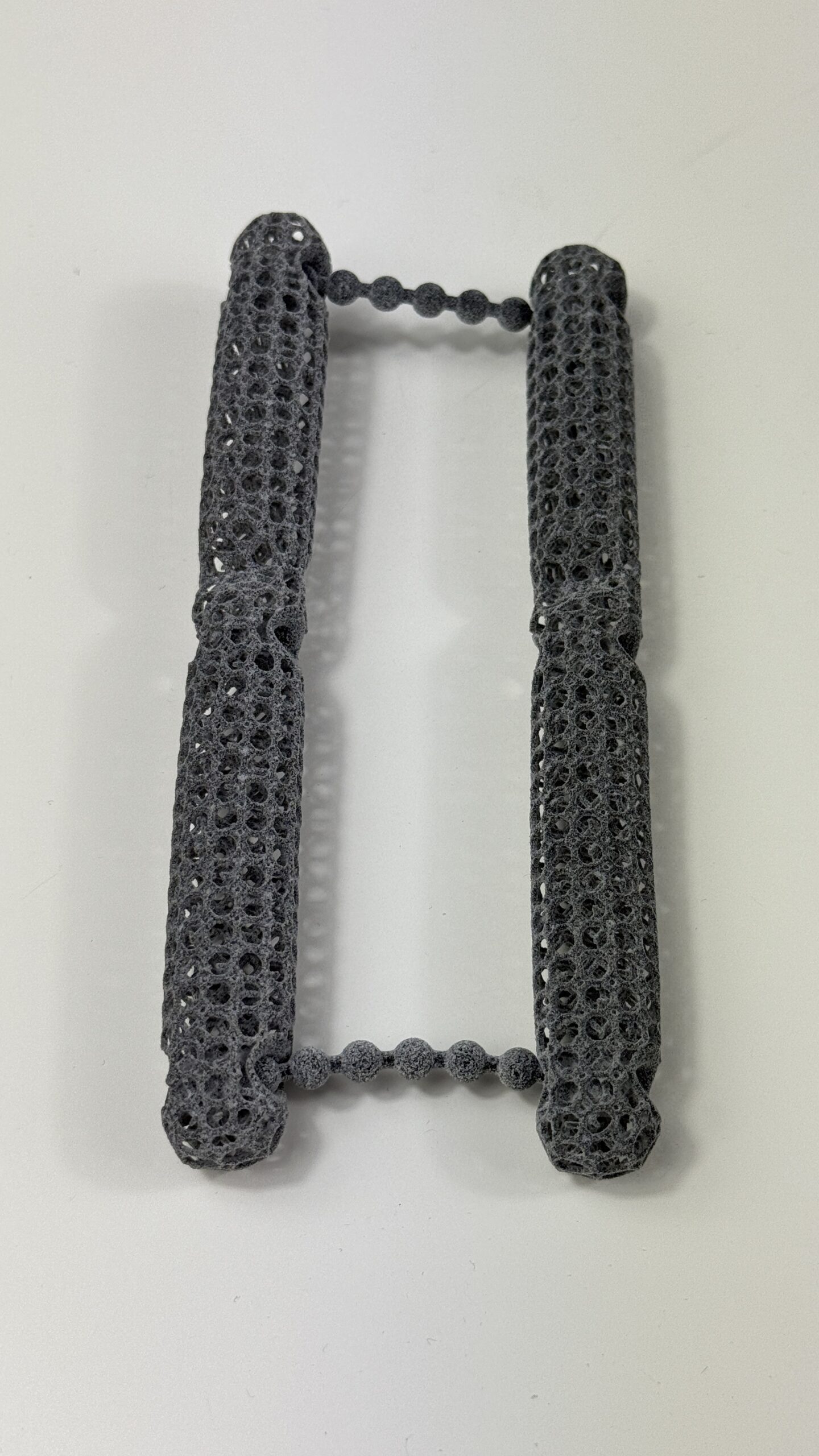
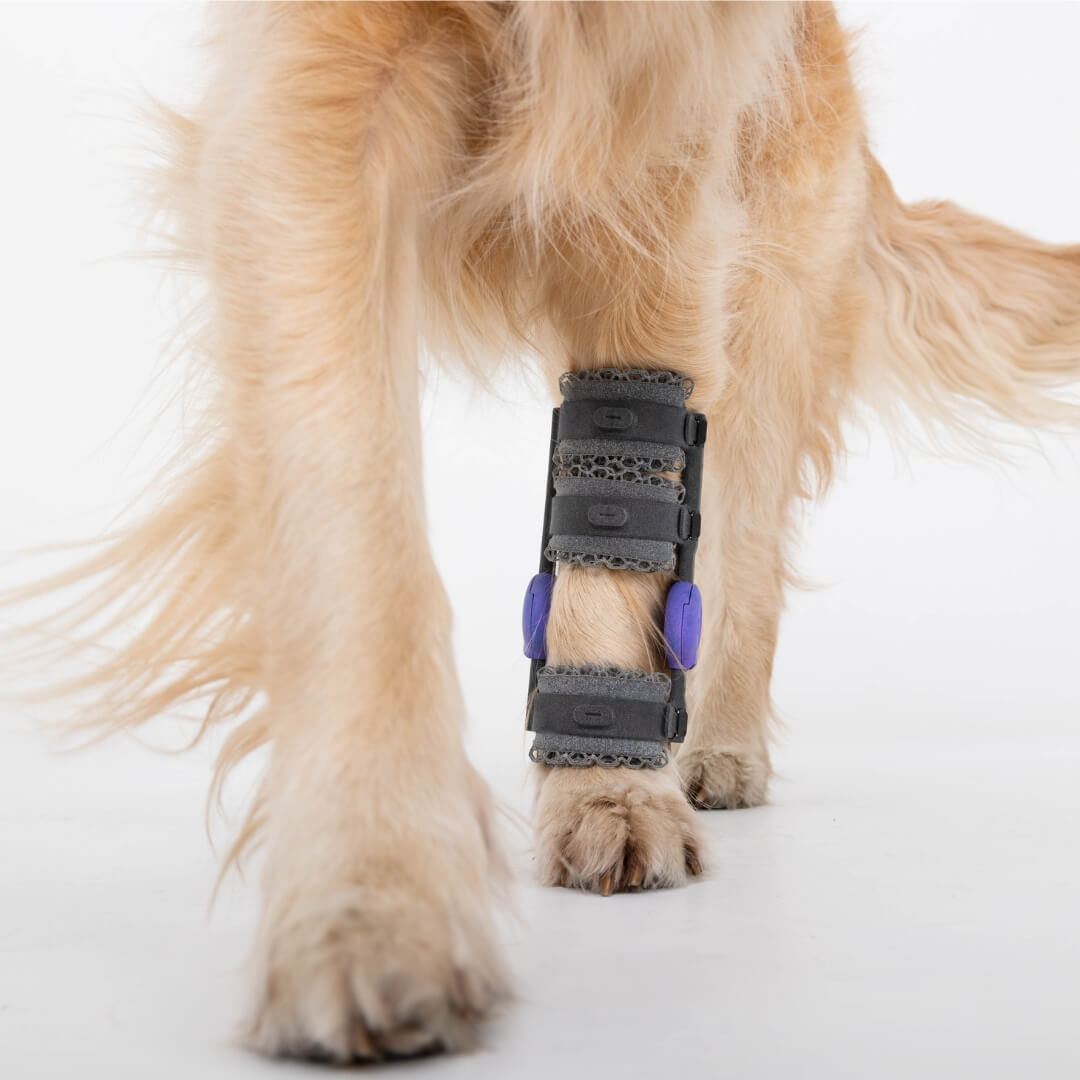
WIMBA makes custom carpal orthoses for dogs, including the WIMBA carpal orthosis in measurement-based GO and scan-based PRO versions. Whether a carpal orthosis is appropriate for a given dog is decided by the veterinarian.
For owners, understanding why a carpal orthotic for dogs has been proposed makes fitting, gradual introduction, and follow-up easier to manage. This guide explains the situations in which veterinary teams may consider a brace, the cases that need another pathway, and how WIMBA GO and PRO differ.
A Clinical Decision, Not a Default Choice
The carpus is a complex region made up of several bones, joint levels, ligaments, fibrocartilage, tendons, capsules, nerves, and vessels. Similar-looking changes in stance can result from very different problems. A wrist that sinks under load may reflect traumatic palmar structure injury, chronic ligament insufficiency, osteoarthritis, developmental laxity, neurological weakness, or compensatory loading.[1]
This is why a vet does not select a carpal orthotic for dogs from appearance alone. The same visible posture can require controlled rehabilitation in one patient, surgical referral in another, and investigation of an underlying neurological or inflammatory disorder in a third. A carpal orthotic for dogs is useful only when its mechanical effect matches the diagnosed problem.
Before recommending a carpal device, the veterinary team should be able to answer:
- Which anatomical structure and carpal joint level are affected?
- Is the instability sagittal, medial, lateral, rotational, or multiplanar?
- Is the condition mild and load-dependent, or severe and present even at rest?
- What movement should the device limit or permit?
- What measurable result will determine whether the plan is working?
Signs That Prompt a Carpal Assessment
An owner may first ask about a dog wrist brace after noticing that the front limb looks lower, flatter, wider, or less stable than before. Other common reasons for assessment include recurrent forelimb lameness, swelling around the carpus, reluctance to load one paw, reduced walking tolerance, a shortened stride, or difficulty landing and turning. Discussion of a carpal orthotic for dogs should begin with these observations, not end with them.
- The carpus sinks or opens excessively when the dog bears weight
- The paw or lower limb rotates inward or outward
- One wrist differs persistently from the other
- Lameness appears after activity or returns after rest
- The dog avoids stairs, jumping into the car, or normal play
- There is pain, heat, swelling, an open wound, or an obvious deformity
These signs justify examination, but they do not confirm that a carpal orthotic for dogs is appropriate. Sudden non-weight-bearing lameness, major trauma, severe pain, an open injury, rapid swelling, or visible deformity requires prompt veterinary care. Applying an unprescribed wrap or brace can obscure the problem or place pressure on damaged tissue.
How Veterinarians Diagnose the Mechanical Problem
Assessment starts with history and observation. The vet may ask whether the change appeared suddenly or gradually, what activity preceded it, whether the dog has pain elsewhere, and whether the posture changes only during weight-bearing. Walking, turning, rising, and standing can reveal compensation that is not visible on the examination table.
The hands-on examination can assess pain, swelling, range of motion, joint level, palmar support, medial and lateral stability, muscle condition, paw placement, skin, circulation, and neurological function. Comparison with the opposite limb can provide context, but both limbs may be abnormal. Stress testing should be performed by a professional rather than repeated at home.
Standard and stress radiographs may help identify fracture, luxation, alignment change, osteoarthritis, and the level of instability. Ultrasound, CT, MRI, arthroscopy, laboratory testing, or referral may be appropriate in selected cases. A prescription for a carpal orthotic for dogs should follow this diagnostic reasoning, not replace it. A dog wrist brace should never be used as a diagnostic test.
Mild Carpal Hyperextension and Sagittal-Plane Laxity
Carpal hyperextension describes excessive backward opening of the wrist under load. It is a movement pattern rather than a complete diagnosis. In a selected mild case, a vet may recommend a carpal hyperextension brace when the goal is to reduce excessive sagittal motion during controlled walking or rehabilitation while preserving the motion required by the treatment plan. The carpal orthotic for dogs is then prescribed around that defined goal.
WIMBA Carpus Orthosis GO is intended for eligible mild, predominantly sagittal-plane instability within its current size, anatomy, weight, and activity criteria. A carpal orthotic for dogs in this pathway may be considered for selected laxity or hyperextension associated with weight shift, compensatory overload, carpal osteoarthritis, or rehabilitation needs.
Mild does not mean self-diagnosed, and conservative care is not automatically the first choice before surgery. The injured structure, joint level, chronicity, pain, progression, and ability to load safely determine whether an orthotic trial is reasonable. A carpal hyperextension brace also requires professional fitting and reassessment. Read the detailed guide to dog carpal hyperextension treatment for a comparison of conservative and surgical pathways.
A retrospective case series evaluated brace treatment in 14 athletic dogs with unilateral carpal valgus or varus ligament instability. Eleven were reported to return to normal function, but the study had no untreated control group and involved a specific frontal-plane instability pattern.[2] It supports further consideration of selected carpal cases, not a promise that every canine carpal orthosis will produce the same result.
Carpal Osteoarthritis and Chronic Instability
Carpal osteoarthritis may follow previous trauma, instability, developmental change, inflammatory disease, or another joint problem. It can contribute to stiffness, pain, swelling, reduced range, and altered loading. Radiographic osteoarthritis alone does not establish a brace indication because clinical function and pain must also be considered.
A vet may consider a carpal orthotic for dogs with osteoarthritis when there is a defined mechanical objective, such as supporting mild instability during prescribed activity. The plan should not claim that the device regenerates cartilage, reverses arthritis, or guarantees comfort. Canine osteoarthritis remains a chronic condition that generally requires individual, multimodal management.[3]
Age alone does not make a dog unsuitable for surgery, and a senior patient should not receive a dog wrist brace solely because an operation sounds undesirable. Anaesthetic risk, comorbidities, type and severity of the lesion, expected benefit, rehabilitation needs, owner goals, and quality of life all belong in the decision. An orthosis can be one option, but it is not a risk-free substitute.
Medication, weight management, controlled exercise, rehabilitation, environmental changes, and surgery may still be indicated. If a custom carpal brace is selected, the clinic should define what change would count as success, such as improved joint control or better tolerance of a prescribed walk, rather than using a general promise of pain relief. Any carpal orthotic for dogs used in long-term arthritis management also needs planned review.
Rehabilitation and Post-Operative Use Require Precise Timing
External support may sometimes be included in a staged rehabilitation or postoperative plan, but the surgeon or rehabilitation professional must define the timing, permitted range of motion, loading, activity, and review schedule. A hinged carpal orthotic for dogs should not be assumed to provide the same protection as a cast, splint, transarticular construct, or other form of strict immobilisation.
This distinction is especially important after arthrodesis. The purpose of arthrodesis is osseous fusion of selected joint levels. The plan is not simply to move from “no motion” to progressively more movement at the fused joint. Postoperative protection follows the surgeon’s protocol and the healing status seen on examination and imaging.
Published outcomes show that dogs can regain useful function after pancarpal arthrodesis, including working dogs, but the evidence describes surgical populations and reported complications rather than proving that a removable orthosis should replace postoperative immobilisation.[4] Current WIMBA GO and Carpus PRO indications do not position these devices for acutely postoperative cases requiring strict immobilisation.
Later in recovery, a clinician may consider a canine carpal orthosis for a suitable functional goal if the anatomy, stability, skin, and surgical plan permit it. A carpal orthotic for dogs introduced at this stage must remain consistent with the surgeon’s restrictions. The decision must come from the treating team. Owners should not switch from prescribed postoperative protection to a commercial brace on their own.
Compensatory Overload, Tripods, and Bilateral Cases
A dog may place additional demand on a front limb because another limb is painful, weak, recovering, or absent. Tripod dogs, overweight dogs, and patients with disease in the opposite limb deserve proactive monitoring. A vet may consider a carpal orthotic for dogs if that assessment reveals mild carpal laxity, early hyperextension, fatigue-related collapse, or another problem that matches current indications.
Compensation alone does not justify routine bracing of a clinically normal wrist. There is no clinical trial showing that a custom carpal brace prevents osteoarthritis or future ligament injury in an otherwise normal limb. Evidence for a carpal orthotic for dogs must not be stretched into a universal prevention claim. “Proactive” should mean detecting and responding to a measurable change, not applying a device because a dog belongs to a risk group.
When both carpi are abnormal, bilateral devices may be considered, but the team must assess the dog’s ability to rise, balance, lie down, and adapt. Skin risk and owner handling demands also double. The article on compensatory overload in dogs explains why the whole movement pattern matters.
Working and Athletic Dogs: Support Is Not Proven Prevention
Agility, hunting, detection, herding, and other demanding activities can expose the forelimbs to repeated loading, acceleration, turning, and landing. Research has quantified high forelimb forces during agility jump landings.[5] That biomechanical observation supports sensible conditioning and workload management, but it does not prove that a carpal orthotic for dogs prevents injury in a normal joint.
Current WIMBA guidance does not position Carpus GO or PRO for agility, sprinting, or repetitive jumping. A carpal hyperextension brace may be used during controlled walking or rehabilitation when a diagnosed mild condition fits the indication, but it should not be treated as permission to continue high-impact activity through pain or instability. The activity rules for a carpal orthotic for dogs remain part of the prescription.
For an athletic dog with no diagnosed carpal problem, prevention should focus on progressive conditioning, rest and recovery, appropriate surfaces, warm-up, technique, body condition, nail and paw care, and early assessment of a persistent gait change. A dog wrist brace should not be added merely because the dog trains hard.
When an Orthosis Is Not Enough
Severe traumatic hyperextension can disrupt the palmar ligaments and fibrocartilage that resist excessive extension. Fractures, luxations, shearing injuries, marked deformity, antebrachiocarpal involvement, progressive collapse, and major multiplanar instability can require surgical assessment. A prolonged brace trial should not delay referral when the lesion is unlikely to remain stable under load.[1]
A carpal orthotic for dogs cannot repair a displaced fracture, reconstruct a completely disrupted ligament complex, treat infection, restore blood supply, or fuse an unstable joint. It also cannot correct every angular deformity or neurological problem. The mechanical target must be one the selected design can actually influence.
Reasons to pause the orthotic pathway and investigate further include:
- Acute severe pain or inability to bear weight
- Fracture, luxation, open injury, or rapidly increasing swelling
- Severe collapse or instability in more than one plane
- Active skin infection, wound, or tissue that cannot tolerate contact
- A neurological deficit without a clearly defined orthotic goal
- Progression despite a correctly selected, fitted, and monitored plan
Choosing Between WIMBA Carpus GO and PRO
WIMBA offers different pathways because not every carpal orthotic for dogs needs the same data or degree of control. Carpus Orthosis GO is intended for eligible mild, predominantly sagittal-plane cases. The clinic submits two required weight-bearing limb photographs and product-specific manual measurements through WimbaAPP. GO does not require WimbaSCAN.
Carpus Orthosis PRO may be considered after case review when the instability is more complex or involves additional planes. PRO uses WimbaSCAN plus manual measurements for scan-based modelling. A version with paw support is available for selected cases in which the clinical plan also requires distal support.
A custom carpal brace is not automatically a PRO device, and a scanned device is not automatically the safer choice. Each canine carpal orthosis must follow the data requirements of its pathway. The correct pathway is the one whose indication, geometry, motion control, activity limits, and fitting requirements match the patient. A carpal orthotic for dogs should not be ordered until that match is clear. A clinic can submit the case for review when candidacy is uncertain.
What Veterinarians Look for in Orthotic Quality
Quality is not defined by the word “custom” alone. A clinically useful carpal orthotic for dogs must support the intended region, stay aligned during movement, avoid focal contact, and produce a gait response consistent with the prescription. A custom carpal brace still requires a dynamic first fitting. A beautiful digital model is not a substitute for observation of the dog in motion.
- Joint alignment: hinges and motion-control components remain at the intended carpal level
- Rotational stability: the frame does not twist or migrate during controlled walking
- Pressure management: hard components avoid direct limb contact and straps apply even tension
- Appropriate motion: the prescribed range is controlled without assuming every movement should be blocked
- Serviceability: approved straps, inserts, fasteners, and Tokens can be reviewed or replaced as intended
- Follow-up: the owner has a clear schedule and knows which changes require contact with the clinic
WIMBA Tokens determine the movement available within applicable devices. The treating veterinarian or rehabilitation professional selects and changes them according to the diagnosis and plan. An owner should not independently make a carpal hyperextension brace more or less restrictive because changing the permitted range changes its clinical function. Motion settings make the carpal orthotic for dogs part of a clinical prescription, not a general accessory.
Fitting, Wear Schedule, and Rechecks
The first fitting should assess position, strap tension, rotation, paw and dewclaw clearance, skin contact, standing posture, and gait. The clinic should compare the dog with and without the carpal orthotic for dogs, while remembering that a new device can alter movement during acclimatisation. Immediate worsening, marked resistance, or hard-component contact requires correction rather than forced practice.
Current WIMBA manuals commonly begin with up to 15 minutes of controlled leash walking, no more than three times daily, followed by increases of about 15 minutes every two days when skin, gait, behaviour, and device position remain acceptable. This is a starting pattern, not a universal prescription. The clinician may set a different plan for the individual canine carpal orthosis.
The device is not intended for continuous 24-hour wear, and the dog must remain supervised. In a prospective study of 43 dogs using custom orthoses or limb-replacement devices, 39 experienced at least one complication. Nine of ten carpal patients had at least one skin complication during the first three months, and four of ten had a mechanical device problem requiring repair.[6]
Those findings do not mean every patient will have a serious problem, but they show why a dog wrist brace needs gradual introduction and planned rechecks. A carpal orthotic for dogs should be removed and the provider contacted if persistent redness, hair loss, abrasion, swelling, pain, worsening lameness, rotation, slipping, reluctance to move, or damaged parts appear.
Do not heat, cut, drill, grind, bend, or reshape the structural frame. Changes in weight, swelling, coat, muscle mass, joint position, or limb geometry can alter fit. A custom carpal brace may need new measurements, refitting, component replacement, redesign, or replacement rather than an improvised home adjustment.
A Collaborative Prescription and Fitting Process
A recommendation is the start of the process. The veterinary team identifies the diagnosis, mechanical target, permitted activity, and review criteria. WIMBA supports device-pathway selection and manufactures the prescribed design from the submitted data. The provider then fits the carpal orthotic for dogs, observes gait, teaches application and removal, and gives the owner a written wear plan. This keeps each canine carpal orthosis connected to the original clinical objective.
- Diagnose: identify the affected structure, joint level, plane, severity, and concurrent disease.
- Define the goal: state what motion or functional problem the device should influence.
- Choose the pathway: confirm whether the case fits GO, requires PRO review, or needs another treatment.
- Collect accurate data: use the required photos and measurements for GO or WimbaSCAN plus measurements for PRO.
- Fit dynamically: assess alignment, contact, stability, and gait at the clinic.
- Introduce gradually: follow the prescribed schedule and monitor skin, behaviour, and movement.
- Reassess: compare the outcome with the original goal and change the plan when needed.
If a vet has suggested a carpal orthotic for dogs, owners should ask which structure is affected, what movement the device should control, how success will be measured, and what signs require removal. These questions turn “wear this brace” into a plan that can be followed and reviewed.
Discuss a Carpal Case With WIMBA
Veterinary professionals can submit the diagnosis, history, imaging where relevant, and intended functional goal for case review. Pet owners can find a WIMBA Provider for assessment, fitting, and follow-up.
Frequently Asked Questions About Carpal Orthotics for Dogs
These answers explain the general decision process. They cannot determine candidacy for an individual dog without veterinary examination.
When might a vet recommend a carpal orthotic for dogs?
A vet may consider a carpal orthotic for dogs when examination identifies a braceable mechanical problem, such as eligible mild carpal laxity, hyperextension, osteoarthritis with a defined support goal, compensatory overload, or a suitable rehabilitation need. The diagnosis and current device indications determine candidacy.
Does carpal hyperextension always need a brace?
No. Hyperextension is a movement pattern with several possible causes and levels of severity. A mild selected case may suit a carpal hyperextension brace, while severe traumatic disruption, fracture, luxation, marked deformity, or progressive collapse may require surgical assessment or another form of stabilisation.
Can a carpal brace replace surgery?
Not automatically. A brace may contribute to conservative management in a suitable case, but it cannot repair a displaced fracture or completely disrupted ligament complex. The lesion, joint level, severity, pain, progression, and expected outcome determine whether surgery, orthotic care, or another plan is appropriate.
Can a dog use a carpal orthosis immediately after surgery?
Only if the surgeon prescribes a device and defines its role. A hinged orthosis is not automatically equivalent to a cast, splint, or strict postoperative immobilisation. Current WIMBA Carpus GO and PRO indications do not cover acutely postoperative cases requiring strict immobilisation.
Should a healthy sporting dog wear a preventive wrist brace?
Routine preventive bracing of a clinically normal carpus is not supported by clinical trials. Athletic dogs benefit from progressive conditioning, workload management, appropriate surfaces, recovery, and early assessment of persistent changes. A device should be tied to a diagnosed mechanical need.
What is the difference between WIMBA Carpus GO and PRO?
GO is intended for eligible mild, mainly sagittal-plane cases and uses two weight-bearing photographs plus product-specific manual measurements. PRO is considered for selected more complex or multiplanar cases and uses WimbaSCAN plus manual measurements. Case review determines the appropriate pathway.
What signs mean the device should be removed?
Remove it and contact the provider if persistent redness, abrasion, swelling, new pain, worsening lameness, marked reluctance, rotation, slipping, repeated hard-component contact, or damaged parts appear. Do not modify the structural frame at home.
Medical Disclaimer: All information on this website is intended for instruction and information purposes only. The authors are not responsible for any harm or injury that may result. Significant injury risk is possible if you do not seek suitable professional advice about your dog’s specific situation. No guarantees of specific results are expressly made or implied on this website.
Scientific References
- Beierer LH. Canine carpal injuries: from fractures to hyperextension injuries. Vet Clin North Am Small Anim Pract. 2021, 51(2):285–303. doi:10.1016/j.cvsm.2020.12.002
- Tomlinson JE, Manfredi JM. Evaluation of application of a carpal brace as a treatment for carpal ligament instability in dogs: 14 cases (2008–2011). J Am Vet Med Assoc. 2014, 244(4):438–443. doi:10.2460/javma.244.4.438
- Cachon T, Frykman O, Innes JF, et al. COAST Development Group’s international consensus guidelines for the treatment of canine osteoarthritis. Front Vet Sci. 2023, 10:1137888. doi:10.3389/fvets.2023.1137888
- Higgins J, Hayes G. Owner satisfaction and prognosis for return to work after pancarpal arthrodesis in working dogs in the United Kingdom: a retrospective study (2011–2020). Acta Vet Scand. 2024, 66:49. doi:10.1186/s13028-024-00759-5
- Pfau T, Garland de Rivaz A, Brighton S, Weller R. Kinetics of jump landing in agility dogs. Vet J. 2011, 190(2):278–283. doi:10.1016/j.tvjl.2010.10.008
- Rosen S, Duerr FM, Elam LH. Prospective evaluation of complications associated with orthosis and prosthesis use in canine patients. Front Vet Sci. 2022, 9:892662. doi:10.3389/fvets.2022.892662
Related reading: Recognizing Carpal Hyperextension in Dogs: Custom Orthosis vs. Off-the-Shelf Support · Veterinary Orthoses: Clinical Indications and Candidate Selection · custom dog brace