 Skip to content

Can Tripod Dogs Live Full, Active Lives After Limb Amputation?
If your dog is about to have a leg amputated—or has recently become a tripod—one question probably matters more than any other: can my dog still have a full, happy life? For many dogs, the answer is yes. Research and real-world experience show that a tripod dog can return to walks, play, travel, and familiar family routines, although the pace and limits of recovery remain individual.
This pet-owner guide explains what dog amputation recovery may look like, how to prepare your home, how a three-legged dog redistributes weight, and which changes deserve veterinary attention. It also explains when an orthosis may help a diagnosed joint problem—and why most dogs do not need a brace simply because they have three legs. For a more clinical discussion of biomechanics and orthotic decision-making, see WIMBA’s Three-Legged Dog Mobility Support: A Clinical Guide.
Good outcomes are common, but every recovery is individual
The best-known outcome figures come from a retrospective survey of owners whose dogs had undergone amputation. They describe owner perceptions, not a guarantee for every patient.1 Age, body condition, the reason for surgery, the health of the remaining limbs, and postoperative complications can all affect tripod dog care and recovery. Follow the surgical team’s instructions even if your dog appears eager to do more.
The Short Answer: Yes, Many Tripod Dogs Thrive
Yes—many can. In a study involving 64 dogs after limb amputation, owners reported high satisfaction and generally positive adaptation.1 These results do not mean that every tripod dog follows the same timeline, but they offer useful reassurance when surgery is medically necessary.
88%
of owners reported a complete or nearly complete return to their dog’s pre-amputation quality of life.
78%
felt their dog’s recovery and adaptation were better than they had expected.
91%
perceived no negative change in their dog’s attitude after surgery.
Newer evidence offers additional reassurance for short-legged breeds
A 2026 multicenter review followed 28 chondrodysplastic dogs after full limb amputation. During the postoperative period, 25 of 28 dogs became independently mobile, and 13 of the 18 owners who completed the survey were very satisfied with the outcome.9 This was a small retrospective study of short-legged breeds using a nonvalidated owner questionnaire, so its results should not be treated as a promise for every tripod dog.
What to Expect During Dog Amputation Recovery
Dog amputation recovery is not a race. A dog may learn a workable three-legged gait before the incision has healed or the remaining muscles have developed enough endurance. The safest plan separates surgical healing, confidence, and long-term conditioning rather than treating them as one milestone.
The first days: healing and safe movement
Pain control, incision protection, rest, and short assisted toilet breaks are the priorities. Use the harness, sling, cone, medication schedule, and activity restrictions provided by the surgical team. Prevent unsupervised jumping, running, and stair use. Never add human pain medication or change a prescribed dose unless a veterinarian tells you to do so.
The early weeks: confidence and coordination
Many dogs become visibly steadier as they practise their new gait. In one prospective study of 12 dogs after hindlimb amputation, a new basic locomotor pattern was established by the 10-day assessment.2 That finding does not mean every dog is fully recovered in 10 days. Wound healing, balance, confidence, strength, and fatigue tolerance develop at different rates.
The following months: strength and a sustainable routine
After the incision is healed and activity has been cleared, walks and rehabilitation can progress gradually. A tripod dog may look enthusiastic before the remaining limbs are conditioned for long distances. Increase only one variable at a time—such as duration, pace, or terrain—and reduce the workload if gait quality declines during or after exercise.
Prepare Your Home for a Three-Legged Dog
A few simple changes can make tripod dog care safer and less stressful, especially during the first stage of dog amputation recovery. Set these up before surgery when possible, so the route from the bed to the garden or toilet area is ready when your dog comes home.
- Create a non-slip route. Use secure runners, rubber-backed mats, or yoga mats across tile, laminate, and other slick surfaces.
- Limit stairs and jumping. Use gates and follow the surgical team’s instructions about ramps or assisted stair use.
- Keep essentials close. Place a supportive bed, water, and an easy exit to the toilet area on one level.
- Plan safe assistance. Ask the veterinary team to demonstrate any prescribed sling or harness before discharge.
- Protect the incision. Use the recommended cone or recovery garment and prevent licking or chewing.
- Track medication and observations. A written schedule helps families record doses, appetite, toileting, wound checks, and questions for follow-up.
How a Tripod Dog Redistributes Weight
A tripod dog does not simply perform the same four-legged movement with one limb missing. Braking, propulsion, balance, and body weight are redistributed across the three remaining limbs. A 2026 study of six forelimb and six hindlimb amputees described repeatable tripedal gait patterns, reinforcing that dogs reorganize how they move rather than following one universal compensation strategy.10 The pattern also differs after forelimb and hindlimb amputation, which is why good tripod dog care monitors the whole body rather than only the leg opposite the amputation.
After a front-leg amputation
The remaining forelimb usually accepts the largest increase in load, while the hindlimbs also contribute more to support and propulsion. Standing and trotting studies have documented measurable redistribution to the remaining front leg, along with changes in carpal, hindlimb, and spinal movement.3,4 A small 2024 pilot study also found higher forces and paw pressure in forelimb-amputee dogs than in four-legged controls.6
After a back-leg amputation
Both forelimbs and the remaining hindlimb take on new roles. Research has identified altered braking and propulsive forces, increased motion at the remaining tarsus, and compensatory changes through the spine.5 These findings support long-term observation of the carpi, remaining stifle and tarsus, back, and overall gait—not an assumption that one particular joint will inevitably fail.
Extra load does not guarantee future injury
Biomechanical studies show changed loading; they do not prove that every three-legged dog will develop arthritis, instability, or pain. The practical message is to protect health, notice change early, and request assessment when function declines—not to restrict a comfortable dog from all activity.
Protecting the Remaining Legs From Overload
Long-term tripod dog care is built around reducing avoidable strain while maintaining enough activity for strength, confidence, and quality of life. These habits provide practical mobility support for tripod dogs at every stage:
- Keep a lean body condition. Every extra kilogram must be carried by three limbs rather than four. Ask your veterinarian to set an appropriate target weight and feeding plan.
- Maintain nails and paws. Overgrown nails, sore pads, torn nails, and interdigital irritation can alter traction and weight-bearing.
- Use reliable footing. Non-slip surfaces, secure ramps, and stable steps reduce sudden slips and awkward landings.
- Build strength progressively. Regular controlled activity is usually more useful than long periods of rest followed by an intense weekend outing.
- Watch all three limbs. Note new stiffness, licking, shortened steps, joint sinking, paw dragging, muscle loss, or reduced endurance.
- Schedule whole-body reviews. Ask the veterinary team to assess the remaining joints, spine, body condition, and muscle symmetry—not only the amputation site.
Keeping Your Tripod Dog Active
An active life does not have to mean an unrestricted one. The right routine depends on age, surgical healing, body condition, the reason for amputation, and the health of the remaining limbs. Ask your veterinarian or a veterinary rehabilitation professional to tailor activity to your dog.
- Choose regular, moderate activity instead of infrequent bursts of high-intensity exercise.
- Start on level, predictable surfaces and introduce hills, uneven ground, or longer distances gradually.
- Use scent games, food puzzles, training, and other enrichment that does not depend on repeated jumping or sprinting.
- Consider rehabilitation options such as controlled therapeutic exercise or hydrotherapy when the veterinarian approves them.
- Wait until the incision is fully healed and the clinical team has given clearance before swimming or underwater treadmill sessions.
- End the session before fatigue causes stumbling, a widening stance, shorter steps, or loss of balance.
Let gait quality set the limit
A tripod dog may still want to chase, jump, or continue walking after movement quality has started to deteriorate. Stop and allow recovery if you see repeated slips, hopping, toe dragging, a progressively widened stance, or difficulty keeping pace. Persistent changes deserve veterinary review.
A Beginner’s Guide to Mobility Aids for Tripod Dogs
If you are new to life with a three-legged dog, it helps to know that “mobility aid” covers several different tools, not one product. A support harness with a handle is usually the first thing owners try, useful for steadying a dog on stairs, slippery floors, or during the first weeks after surgery. Home adaptations, such as non-slip runners, ramps instead of steps, and raised food bowls, reduce daily strain on the remaining legs without any device at all. A custom orthotic brace is considered later, only if a veterinarian or rehabilitation professional identifies a specific unstable joint that needs mechanical support. A wheelchair is generally reserved for dogs whose mobility needs go beyond what bracing, a harness, or home changes can provide.
There is no single “right” aid for every tripod dog, and many dogs never need more than sensible home adaptations and a well-fitted harness. The safest starting point as a beginner is not to buy equipment first, but to have your dog’s gait and remaining joints assessed, so that any aid you add actually matches a need your dog has, rather than a need another dog’s owner described online.
When to Call Your Veterinarian
Your surgical team should provide individual discharge instructions and an emergency contact route. Wound complications after limb amputation are documented, so a concern is better discussed early than watched until the next scheduled appointment.7
During dog amputation recovery
Contact the surgical team promptly for bleeding that does not stop, an opening incision, increasing heat or swelling, discharge, odor, worsening bruising, uncontrolled pain, repeated vomiting, inability to give or keep down prescribed medication, or eating, drinking, and urination that do not match the discharge plan. Collapse, difficulty breathing, severe weakness, pale gums, or major bleeding require emergency veterinary care.
After the initial recovery period
Arrange an assessment for a new or recurring limp, joint sinking or overextension, paw dragging or knuckling, difficulty rising, reduced walking distance, repeated slips, visible muscle loss, persistent licking, or a change in mood or willingness to move. These signs can come from a remaining limb, the spine, another painful condition, or an unsuitable activity plan, so diagnosis should come before adding a brace or changing exercise.
When Orthotic Support May Help a Tripod Dog
Custom orthoses are not a routine requirement for every tripod dog, and there is no controlled evidence that preventive bracing of a healthy joint stops future arthritis. Orthotic support becomes relevant when examination identifies a specific problem—such as carpal hyperextension, tarsal instability, or selected stifle instability—and the veterinary team defines what the device should support or control.
WIMBA designs custom, 3D-printed orthoses around a veterinarian’s diagnosis and functional goals. This form of mobility support for tripod dogs works alongside body-weight management, rehabilitation, pain management, and regular reassessment; it does not replace them.
Support for a remaining forelimb
When a veterinarian diagnoses mild carpal hyperextension, carpal osteoarthritis, or another suitable support need, a WIMBA Carpus Orthosis GO may be considered. The current GO process uses two patient photos and guided manual measurements in WimbaAPP; it does not require WimbaSCAN. The purpose is to support the diagnosed carpus during defined activities, not to immobilize every remaining front leg automatically.
Support for a remaining hindlimb
A diagnosed tarsal problem may fit the WIMBA Tarsus Orthosis GO pathway, while selected stifle conditions requiring more controlled motion may lead a veterinary professional to consider a WIMBA Stifle Orthosis PRO. GO devices use photos and guided manual measurements; selected PRO cases combine manual measurements with WimbaSCAN. The joint, severity, and clinical goal determine the pathway.
Fit, break-in, and skin checks matter
Skin irritation, mechanical device problems, and non-acceptance are recognized complications of canine orthosis use.8 A gradual wear schedule, daily skin inspection, cleaning, and planned fit reviews are part of safe use. Remove the device and contact the veterinary team if redness persists, a sore develops, the brace moves or breaks, or gait becomes worse.
Real Tripod Dog Stories: Juri and Maia
Real cases can show how a device fits into a broader plan, but they do not predict another dog’s outcome. Juri and Maia illustrate two different patterns: one remaining forelimb already vulnerable after front-leg amputation, and both forelimbs becoming overloaded after hind-leg amputation. Neither case suggests routine bracing for every tripod dog.
Juri: targeted support for the only remaining forelimb
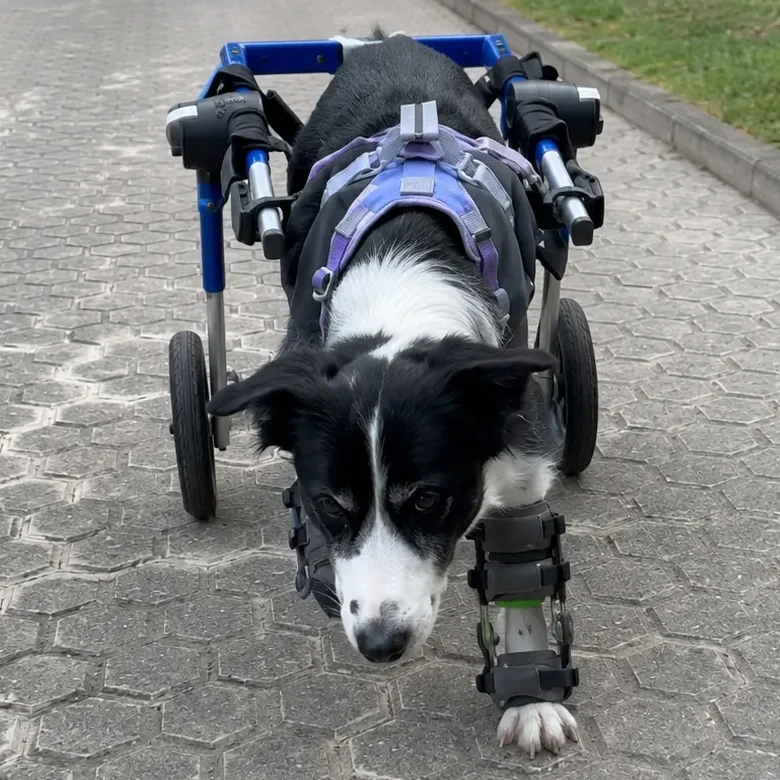
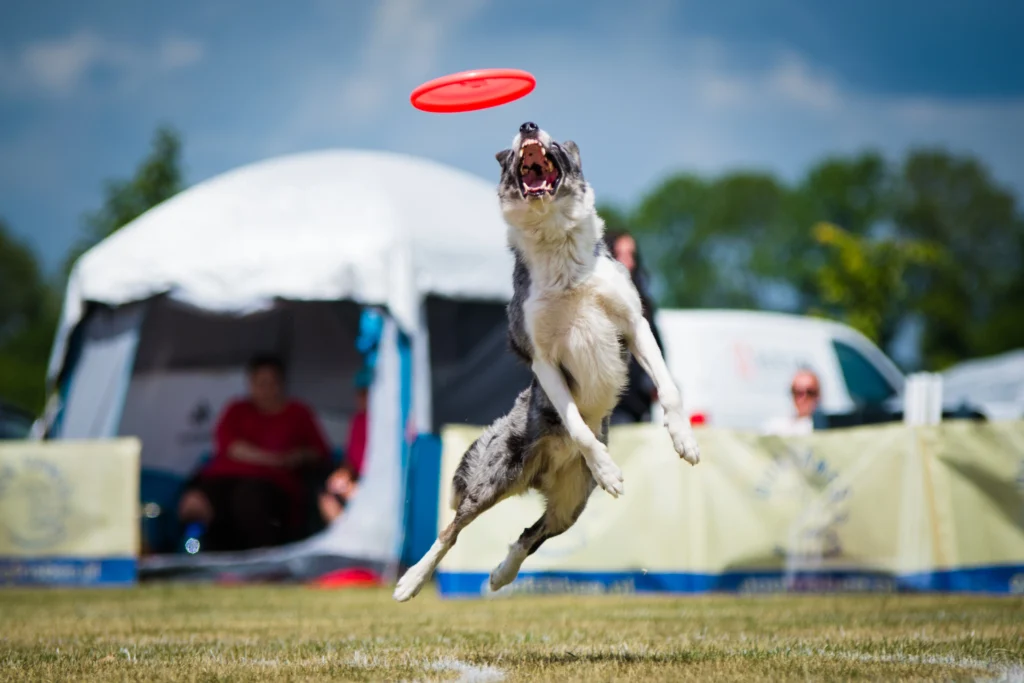
Juri, a Border Collie and former sport dog, underwent a high left forelimb amputation after severe carpal disease and osteomyelitis. His remaining right carpus already showed degenerative change and a tendency to hyperextend, so his team incorporated a WIMBA Carpus Orthosis GO for selected activity. The brace is one part of a wider plan that includes controlled exercise, rehabilitation, hydrotherapy, skin checks, and ongoing monitoring.
Maia: supporting both forelimbs after hindlimb amputation
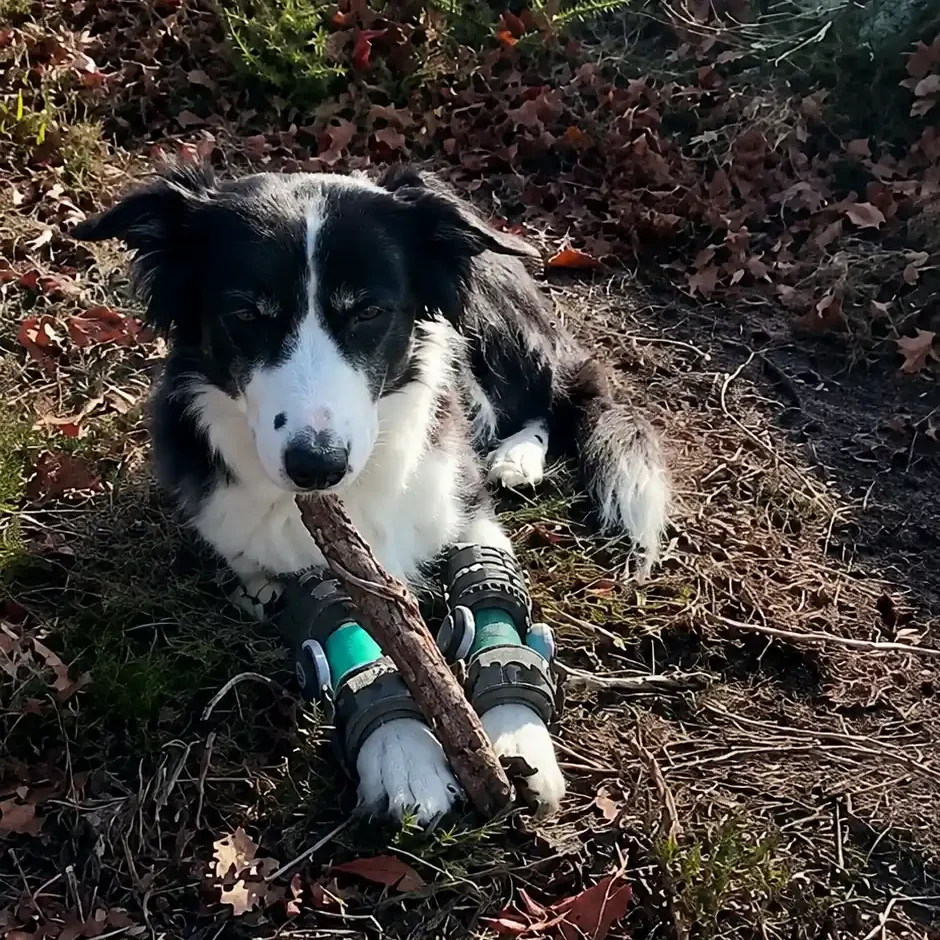
Maia, an approximately 11-year-old Border Collie, initially adapted well after right hindlimb amputation. Nearly one year later, progressive forelimb overload and left carpal hyperextension became more apparent. Her care team introduced bilateral WIMBA Carpus Orthoses GO alongside rehabilitation, home exercises, weight management, a suitable harness, and a wheelchair for longer walks. She needed gradual training and follow-up adjustments before becoming comfortable in both braces.
Frequently Asked Questions
Can a tripod dog live a full, active life?
Yes. Many dogs return to walks, play, and familiar routines after amputation. In one 64-dog study, 88% of owners reported a complete or nearly complete return to pre-amputation quality of life. Individual results still depend on health, body condition, the reason for surgery, recovery, and the condition of the remaining limbs.
How long does dog amputation recovery take?
The timeline varies. Some dogs establish a basic three-legged gait within days, but incision healing, confidence, muscle conditioning, and endurance continue over subsequent weeks or months. Follow the surgeon’s restrictions and review schedule rather than increasing activity according to a fixed calendar.
Will my tripod dog’s other legs get injured from extra work?
The remaining limbs do carry redistributed load, but that does not mean injury is inevitable. Keeping a lean body condition, providing secure footing, building exercise gradually, maintaining paws and nails, and arranging veterinary checks can reduce avoidable strain and help identify a new problem early.
Can three-legged dogs still run, swim, and play?
Many can, with individual limits and sensible progression. Running and play should return gradually, while swimming or underwater treadmill work should wait until the incision is fully healed and the veterinary team has given clearance. Stop before fatigue changes balance or gait quality.
When can orthotic support help a tripod dog?
An orthosis may help when a veterinarian identifies a specific joint problem, such as carpal hyperextension, tarsal instability, or selected stifle instability, and defines a support goal. It is not automatically required after amputation and should remain part of a wider plan for weight, activity, rehabilitation, and follow-up.
Which signs after amputation require a call to the vet?
Contact the surgical team for an opening incision, persistent bleeding, increasing heat or swelling, discharge, odor, worsening pain, repeated vomiting, inability to give medication, or eating, drinking, and urination that do not match the discharge plan. Collapse, difficulty breathing, pale gums, severe weakness, or major bleeding require emergency care.
Help Your Tripod Dog Thrive
A safe recovery, lean body condition, progressive activity, secure footing, and regular assessment form the foundation of tripod dog care. If a diagnosed joint problem develops, your veterinary team can decide whether rehabilitation or custom mobility support for tripod dogs should become part of the plan. Explore WIMBA’s owner and clinical resources or find a provider who can assess your dog.
Medical disclaimer: This article is intended for general educational purposes only and is not a substitute for veterinary examination, diagnosis, treatment, postoperative instructions, or rehabilitation planning. WIMBA orthotic devices are selected, fitted, and monitored by qualified veterinary professionals according to the individual patient’s condition. Contact your veterinarian or an emergency veterinary service if your dog develops a wound problem, uncontrolled pain, breathing difficulty, collapse, major bleeding, reduced function, or a new change in gait.
Scientific References
- Dickerson VM, Coleman KD, Ogawa M, et al. Outcomes of dogs undergoing limb amputation, owner satisfaction with limb amputation procedures, and owner perceptions regarding postsurgical adaptation: 64 cases (2005–2012). Journal of the American Veterinary Medical Association. 2015;247(7):786–792. doi:10.2460/javma.247.7.786
- Galindo-Zamora V, von Babo V, Eberle N, et al. Kinetic, kinematic, magnetic resonance and owner evaluation of dogs before and after the amputation of a hind limb. BMC Veterinary Research. 2016;12:20. doi:10.1186/s12917-016-0644-5
- Cole GL, Millis D. The effect of limb amputation on standing weight distribution in the remaining three limbs in dogs. Veterinary and Comparative Orthopaedics and Traumatology. 2017;30(1):59–61. doi:10.3415/VCOT-16-05-0075
- Jarvis SL, Worley DR, Hogy SM, et al. Kinematic and kinetic analysis of dogs during trotting after amputation of a thoracic limb. American Journal of Veterinary Research. 2013;74(9):1155–1163. doi:10.2460/ajvr.74.9.1155
- Hogy SM, Worley DR, Jarvis SL, et al. Kinematic and kinetic analysis of dogs during trotting after amputation of a pelvic limb. American Journal of Veterinary Research. 2013;74(9):1164–1171. doi:10.2460/ajvr.74.9.1164
- Rodríguez O, Regueiro-Purriños M, Figueirinhas P, et al. Dynamic and postural changes in forelimb amputee dogs: a pilot study. Animals. 2024;14(13):1960. doi:10.3390/ani14131960
- Raske M, McClaran JK, Mariano A. Short-term wound complications and predictive variables for complication after limb amputation in dogs and cats. Journal of Small Animal Practice. 2015;56(4):247–252. doi:10.1111/jsap.12330
- Rosen S, Duerr FM, Elam LH. Prospective evaluation of complications associated with orthosis and prosthesis use in canine patients. Frontiers in Veterinary Science. 2022;9:892662. doi:10.3389/fvets.2022.892662
- O’Neill M, Wustefeld-Janssens B, Griffin M, et al. Full limb amputation in chondrodysplastic dog breeds results in acceptable mobility and high owner satisfaction. Journal of the American Veterinary Medical Association. 2026;264(6):1–8. doi:10.2460/javma.25.08.0554
- Self Davies ZT, Savage AL, Usherwood JR. Locomotion on three legs: the tripedal gaits of canine amputees. Proceedings of the Royal Society B: Biological Sciences. 2026;293(2069):20253159. doi:10.1098/rspb.2025.3159