




Written by:
Dr. Emily Hall DVM, CCRT, CPAT-KA
What is Nose-to-hand target (hand targeting)?
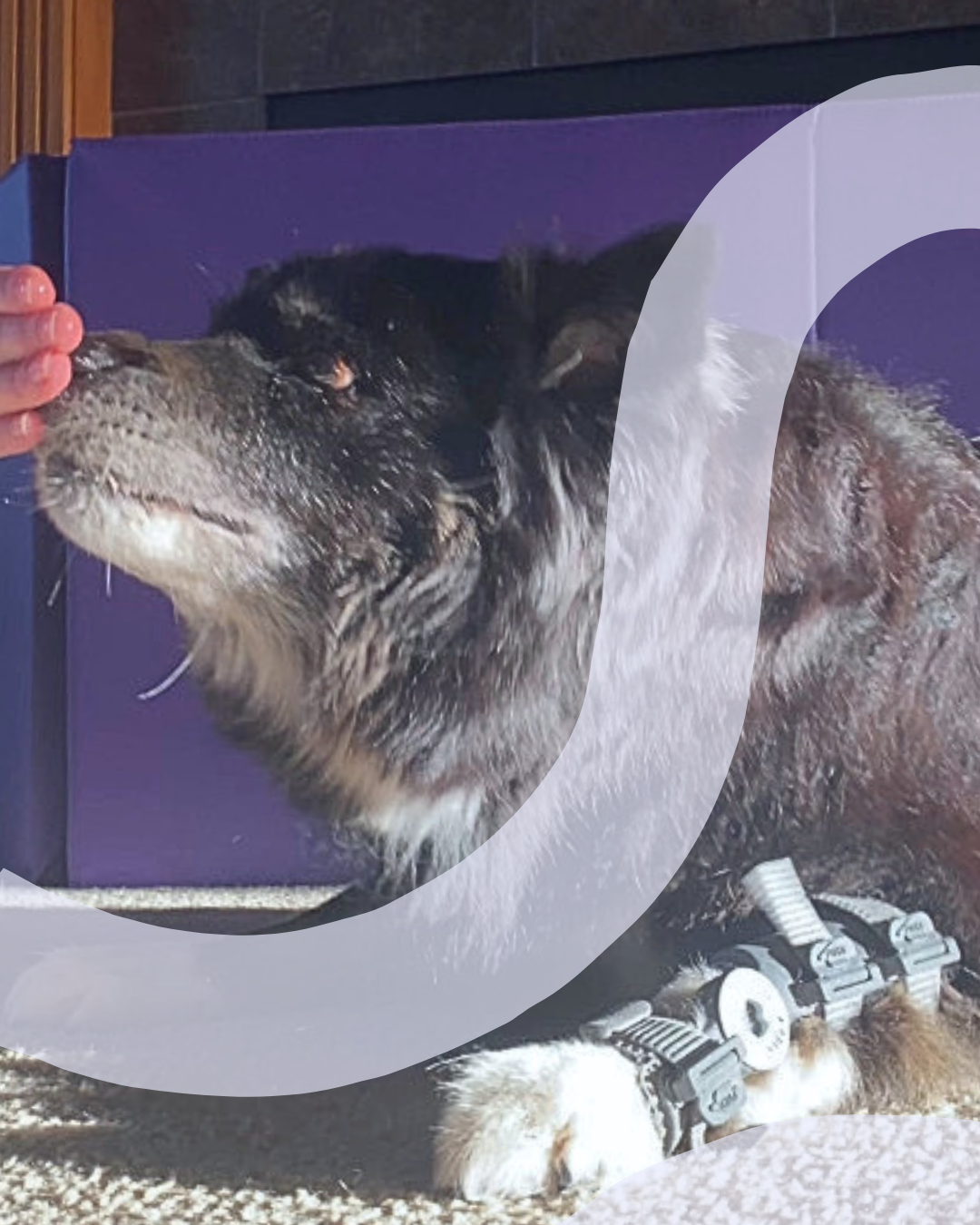
Hand targeting teaches your dog to touch your hand with their nose on cue. It is a cooperative, voluntary behavior that supports redirection, positioning, low-stress handling and many rehabilitation tasks.
Why teach targeting for rehab and clinic care?
Targeting builds focus, impulse control and clear communication. It is especially useful when working with orthoses and prostheses because it lets you:
• Position the head or body for imaging, such as WimbaSCAN.
• Guide a dog into Cave for safe donning checks and strap adjustments.
• Encourage stepping, reaching and weight shift during gait and balance work.
• Redirect attention quickly without physical force during stressful moments.
Training protocol: step-by-step
Work in a calm, low-distraction environment. Keep sessions short, about 2–5 minutes.
- Present a flat hand a few inches from your dog’s nose. Wait patiently.
- Mark any interest (such as sniffing) with your reward marker, then give a treat. If using your right hand as the target, use your left hand to deliver the treat to the dog at the right “target hand” area while bringing the “target hand” down to your side.
- Once they consistently investigate, only mark and reward when their nose touches your hand. This helps reduce licking or pawing. DO NOT REWARD pawing/licking/open mouth contact.
- Gradually increase the distance so the dog must take a step to touch your hand. Practice in different directions and with both hands.
- Add the verbal cue “Touch” or “Target” only after they respond consistently to the visual hand cue. Say the word as you present your hand, so they learn to connect the word to the action.
Clinic and rehab application examples:
WimbaSCAN and imaging
Use targeting to orient the head and reduce movement. Ask the dog to target a hand placed at the required angle. Mark and reward stillness immediately after the scan position is achieved.
Donning and fit checks
Ask the dog to hold Cave while you check straps and pressure points. Targeting can be used to keep the head or body oriented away from sensitive areas while you work, or to encourage a slight weight shift onto the device limb during fit adjustments.
Weight shift and gait work
Place your hand so the dog must reach or step toward it. Mark the moment weight shifts onto the limb with the orthotic on. Use short, frequent repetitions to teach safe loading patterns.
Safe redirection and recall alternative
At close range, a quick touch cue can shift attention from a trigger. In controlled settings, targeting can serve as a short range recall or a way to guide a dog onto a mat or platform.
Safety and contraindications!
• Stop training and consult a professional if the dog shows avoidance, fear, growling or mouthing.
• Do not force contact or position. Never push a dog into a posture they resist.
• Consult your veterinarian before increasing activity for dogs with orthopedic, cardiac or other medical conditions.
• Keep sessions short and voluntary. Frequent voluntary participation is more productive than fewer forced repetitions.
Troubleshooting quick guide
• Dog licks your hand: require closed-mouth contact before marking.
• Dog paws or mouths: lower criteria and mark smaller approximations of correct nose contact. Reward calm behavior.
• Dog loses interest: shorten sessions, raise reinforcer value, and end on a high note.
• Dog avoids the hand: return to earlier steps, use consent checks, and consider soft handling desensitization.
Practice tips for lasting generalization
• Consistency matters: use the same marker, the same cue word and clear timing.
• Generalize across locations: practice in the house, in the yard and in clinical spaces.
• Use two hands: teach both left and right targeting so you can position the dog reliably.
• Link to function: practice targeting while stepping, while entering Cave, and while performing donning checks, so the behavior becomes a practical tool rather than a trick.
Final note
Hand targeting is a simple cooperative skill with many clinical applications. Taught with clear marking, immediate reinforcement and respect for the dog’s consent, it becomes a reliable, low stress method to position and calm your dog during imaging, device fitting and rehabilitation.
🔗 See Handout Infographic