 Skip to content

Dog Prosthesis vs Orthosis: What Comes First for a Tripod Dog?
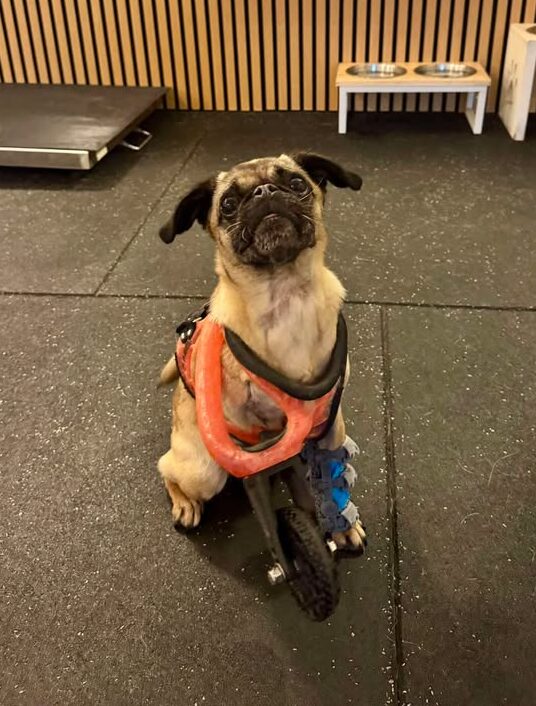
Dog prosthesis vs orthosis is not a choice between two devices that solve the same problem. A prosthesis replaces a missing limb or limb segment. An orthosis supports a limb and joint the dog still has. For a tripod dog, the first priority is to assess the three remaining limbs and protect any joint already showing overload, instability, pain, or loss of control.
That does not mean every tripod dog automatically needs a brace, and it does not mean a prosthesis should never be considered. It means the remaining limbs should not be ignored while attention is focused on replacing the missing one. This dog prosthesis vs orthosis guide explains the two roles, the limits of each device, and a safer order for making decisions with a veterinary and rehabilitation team.
Dog Prosthesis vs Orthosis: The Shortest Answer
- A prosthesis replaces: it creates an external substitute for missing anatomy.
- An orthosis supports: it controls or assists a selected movement in an existing limb or joint.
- Neither device replaces the other: each must have its own diagnosis, mechanical objective, fitting process, and follow-up plan.
- WIMBA no longer offers prosthetic devices: WIMBA now focuses exclusively on custom orthotic support for existing limbs and joints.
Dog Prosthesis vs Orthosis: The Practical Difference
In precise clinical terminology, the supportive device is an orthosis. Pet owners also commonly use the words orthotic or brace. The dog prosthesis vs orthosis distinction is based on the anatomy each device acts on, not on which product looks more advanced or provides more material around the limb.
| Question | Dog prosthesis | Dog orthosis |
|---|---|---|
| What does it act on? | A missing limb or missing distal segment | An existing limb, joint, or body region |
| Primary purpose | Provide an external replacement and, in selected cases, recreate a fourth point of contact | Limit, guide, or support a selected movement and improve external stability |
| Typical clinical question | Can this dog safely use a prosthetic system with the available anatomy, skin, range of motion, and neuromuscular control? | Which existing joint is unstable or painful, which motion requires control, and during which activities? |
| What it cannot do | Automatically treat arthritis, ligament injury, or instability in another limb | Replace the missing limb or recreate the function of a complete fourth leg |
| Provider pathway | Requires a veterinary prosthetic specialist and a provider that offers prostheses | WIMBA supports suitable cases through custom GO or PRO orthotic pathways |
A well-fitted prosthesis may alter how load is shared, while a well-selected orthosis may support a vulnerable joint. Those benefits are not interchangeable. A prosthetic leg for a dog does not remove the need to examine the other three limbs, and an orthosis cannot create the missing ground contact that a prosthetic system is intended to provide.
Dog Prosthesis vs Orthosis: Why the Remaining Limbs Come First
Limb loss changes the dog’s centre of gravity, contact time, braking, propulsion, spinal motion, and ground reaction forces. In a force plate study of 10 amputee dogs, the remaining limbs showed significant changes in loading and contact time compared with 22 four-legged dogs.1 Later studies confirmed that forelimb and hindlimb amputees use different compensatory strategies, but both groups redistribute work across the remaining limbs.23
This is why remaining limb protection after amputation begins with assessment rather than a device catalogue. The veterinary team needs to identify where the dog is placing weight, whether a carpus or tarsus is collapsing, whether an existing cruciate or osteoarthritis problem is present, and whether fatigue changes the gait. A dog prosthesis vs orthosis discussion is incomplete if it looks only at the amputated side.
14% more weight
was distributed to the remaining forelimb while trotting after forelimb amputation in one study.2
Largest standing increase
was measured in the contralateral forelimb after both forelimb and hindlimb amputation in a 20-dog study.4
50.7% to 55.5%
of body weight was carried by the contralateral forelimb in two forelimb-amputation groups in a 39-dog walkway study.5
These group results explain why tripod dog mobility support should be proactive, but they do not prove that every tripod will develop arthritis, ligament failure, or pain. Adaptation can still be very good: in an owner survey of 64 amputee dogs, 88% were reported to make a complete or nearly complete return to their pre-amputation quality of life.6 The studies also do not prove that fitting a brace to a clinically normal joint prevents future disease. Evidence-based remaining limb protection after amputation means monitoring early and intervening when examination identifies a real target.
Dog Prosthesis vs Orthosis Starts With Assessment
The most useful first step in the dog prosthesis vs orthosis pathway is a whole-patient mobility assessment. Ideally, this begins before amputation when surgery is planned, then continues after wound healing and during rehabilitation. In an emergency or when amputation has already taken place, a baseline examination can still document how the dog has adapted and which areas require follow-up.
- Review the amputation and healing status. Record the reason for surgery, amputation level, residual limb condition, scars, pain, sensation, and any current restrictions.
- Examine all remaining limbs. Check carpal, tarsal, stifle, elbow, shoulder, and hip function instead of assuming that only the diagonal limb is at risk.
- Observe standing and gait. Compare posture, paw placement, step length, endurance, turning, braking, and movement on relevant surfaces.
- Identify existing disease. Osteoarthritis, CCL disease, ligament laxity, neurological weakness, obesity, previous injury, and muscle loss can change priorities.
- Define the functional goal. Comfortable household walking, longer outdoor activity, rehabilitation, return to sport, and a fourth point of contact are different objectives.
- Plan reassessment. Photographs, video, weight, skin findings, and simple functional tests create a baseline for judging change.
Protection does not automatically mean bracing
In a dog prosthesis vs orthosis plan, protection does not automatically mean bracing. A comfortable tripod with stable joints may need weight management, suitable exercise, non-slip surfaces, rehabilitation, and scheduled monitoring rather than an orthosis. Orthotic support for tripod dogs becomes relevant when a clinician identifies a joint, movement, or tissue that the device can reasonably support.
Dog Prosthesis vs Orthosis: When an Orthosis Comes First
An orthosis is the logical starting device when the clinical problem is located in a limb the dog still has. In that situation, the dog prosthesis vs orthosis question is answered by anatomy: replacing the missing limb does not directly stabilise the affected carpus, tarsus, or stifle. The orthosis addresses the existing joint, while rehabilitation and medical care address the wider patient.
A remaining joint is already unstable
Visible carpal hyperextension, tarsal collapse, multiplanar instability, or another documented mechanical problem may create a clear target for orthotic support for tripod dogs. The device should be selected for the joint and permitted range of motion, not simply because the dog has three legs.
Known disease increases the demand on adaptation
A tripod may already have osteoarthritis, CCL disease, a previous tendon or ligament injury, weakness, or reduced range of motion in a remaining limb. Within a dog prosthesis vs orthosis plan, tripod dog joint support may then form part of a multimodal approach that also includes pain management, rehabilitation, body-condition control, and activity modification.
The rehabilitation plan needs controlled movement
A clinician may prescribe an orthosis to limit excessive extension, guide alignment, or provide a repeatable support condition during selected exercises. This type of tripod dog joint support must follow the surgeon’s or rehabilitation clinician’s restrictions. A hinged brace should not be assumed to provide the same stabilisation as surgery, a cast, or another postoperative construct.
In each of these situations, early remaining limb protection after amputation means responding to a diagnosed problem before it progresses further. It does not mean promising that a brace will prevent all future injury. The scientific literature documents altered loading after amputation, but controlled trials have not shown that routine prophylactic bracing prevents osteoarthritis in an otherwise healthy tripod limb.
Dog Prosthesis vs Orthosis: What an Orthosis Cannot Do
A clear dog prosthesis vs orthosis explanation also needs boundaries. An orthosis may support a diagnosed joint, but it does not biologically repair a complete ligament rupture, reverse limb loss, or guarantee a normal gait. It should not be used to postpone surgery when surgical stabilisation is indicated.
- It cannot replace the missing limb or reproduce the function of a complete fourth leg.
- It cannot eliminate all compensatory movement through the spine and other joints.
- It cannot guarantee prevention of arthritis, CCL injury, tendon injury, or future pain.
- It cannot compensate for an incorrect diagnosis, an unsuitable range-of-motion setting, or poor fit.
- It cannot be fitted once and forgotten. Skin checks, gradual introduction, cleaning, and reassessment remain essential.
A prospective study of 43 dogs using custom orthoses or prostheses found that 39 experienced at least one complication. Skin complications were particularly common in the first three months, and prosthesis patients also showed the highest rate of non-acceptance in that small study group.9 These findings support planned follow-up for both sides of the dog prosthesis vs orthosis decision.
Dog Prosthesis vs Orthosis: When a Prosthesis May Enter the Plan
A prosthetic leg for a dog is most established for a partial-limb amputation or distal limb defect where sufficient healthy anatomy remains to control and retain a socket. Candidacy depends on more than the name of the missing segment. The residual limb’s length and shape, skin and scar quality, pain, sensation, joint range, muscle control, body size, temperament, activity, and the owner’s ability to manage daily fitting all matter.
In the dog prosthesis vs orthosis pathway, prosthetic planning is therefore a separate specialist assessment. It may be discussed before an elective partial amputation so that the surgical level and soft-tissue coverage can be planned with the future socket in mind. If a full limb has already been removed, conventional socket options may be much more limited.
| Evidence | What it suggests | Important limitation |
|---|---|---|
| 47 partial-limb dogs, retrospective owner survey7 | 46 owners reported positive satisfaction and 42 dogs were scored as having acceptable to full function | Survey response was 37%, outcomes were owner reported, and short-term complications were reported in 62% |
| 12 partial-limb dogs, prospective case series8 | 11 dogs demonstrated a quadrupedal gait during objective analysis | 10 dogs had complications, including suspension difficulty, pressure sores, bursitis, and infection; two owners stopped using the prosthesis |
| One complete forelimb amputee, 2026 study10 | A custom system improved several static and gait measurements in that individual dog | A single case cannot establish routine candidacy, expected outcome, or suitability for other complete amputees |
In a dog prosthesis vs orthosis comparison, these studies show that prosthetic use can be feasible for selected dogs, but they do not support a universal rule that every partial amputee should receive one. They also show why a prosthetic leg for a dog should not be presented as a quick accessory. Adaptation, suspension, skin tolerance, repairs, rehabilitation, and owner involvement can determine whether the system is used consistently.
WIMBA does not provide this service
WIMBA no longer designs, manufactures, or fits prosthetic limbs. Owners interested in a prosthesis need a referral to a different veterinary prosthetic provider. WIMBA can assess only the separate question of whether a custom orthosis may be appropriate for an existing limb or joint.
Dog Prosthesis vs Orthosis: Can Both Devices Be Used?
Potentially, yes. The devices are not mutually exclusive because they act on different anatomy. A prosthesis may replace a missing segment on one side, while an orthosis may support a diagnosed instability in another limb. The dog prosthesis vs orthosis decision can therefore become a coordinated plan rather than an either-or choice.
That combination should not be prescribed automatically. Introducing a prosthesis can change stance, step timing, and load distribution again, so the orthotic settings and rehabilitation goals may need reassessment. Effective tripod dog mobility support follows the dog’s response to each change instead of assuming that adding more equipment always provides more protection.
The same principle applies when no prosthesis is pursued. An orthosis can still be valuable if a remaining joint has a defined need, while a dog with stable joints may require monitoring and rehabilitation without either device. The correct answer to dog prosthesis vs orthosis may be one device, both devices, or neither at that stage.
Kalina: Orthotic Support for the Limbs She Still Uses
A real case can illustrate the difference, but it cannot predict another dog’s outcome. Kalina’s treatment was based on her individual examination and formed part of a broader veterinary and rehabilitation plan.
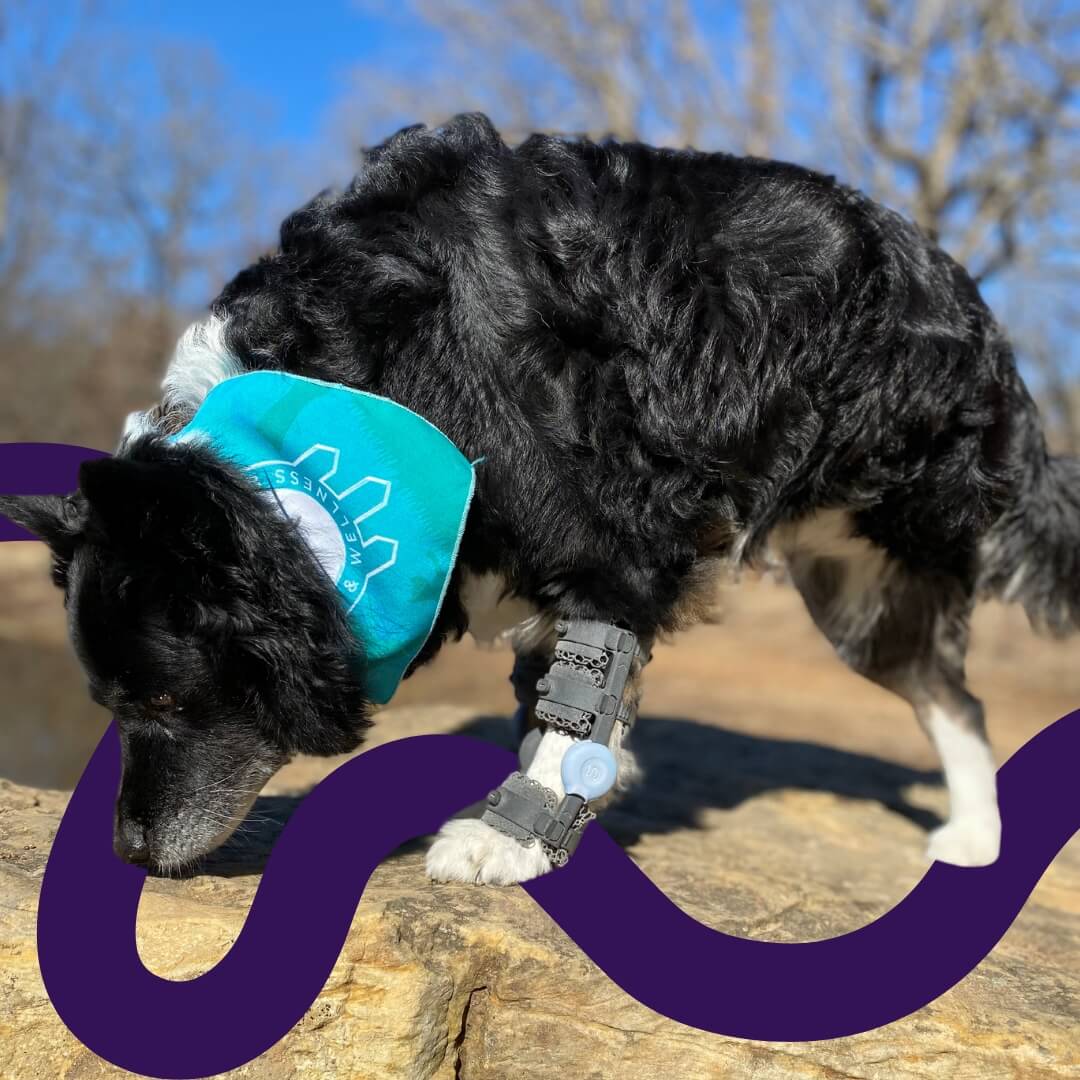
CASE REPORT
Kalina: bilateral carpal support after hindlimb loss
Kalina lost her left hindlimb as a young adult and later developed osteoarthritis, a CCL rupture, and bilateral carpal hyperextension. Bilateral WIMBA Carpus Orthoses GO became part of her wider veterinary and rehabilitation plan. Her story illustrates support for existing joints, not replacement of the missing limb.
Kalina did not need an orthosis because she was simply a tripod. She needed tripod dog joint support because both carpi were hyperextending while she was also living with osteoarthritis and CCL disease. Her case makes the dog prosthesis vs orthosis distinction visible: the WIMBA devices act on her existing front limbs and do not replace the missing hindlimb.
Dog Prosthesis vs Orthosis: A Safer Order for the Decision
For most owners, “orthosis first” should be understood as remaining-limb assessment and protection first, not buy a brace for every tripod first. This order keeps the dog prosthesis vs orthosis decision tied to clinical need.
- Stabilise the immediate medical problem. Complete diagnostic work, surgery, wound care, pain management, and the initial recovery plan.
- Create a baseline for the remaining limbs. Examine gait, all joints, muscle condition, skin, body condition, and current activity.
- Start the wider mobility plan. Use appropriate rehabilitation, controlled activity, weight management, non-slip surfaces, and regular monitoring.
- Add an orthosis when there is a defined target. Select the device for documented instability, excessive movement, or another clinician-defined rehabilitation goal.
- Explore a prosthesis separately when appropriate. Ask an independent prosthetic specialist whether the residual anatomy, patient, and owner goals support that pathway.
- Reassess after every change. A new orthosis, prosthesis, wheelchair, exercise progression, or change in body weight can alter gait and load distribution.
This sequence protects the part of the mobility system that is already working hardest while leaving the prosthetic option open for suitable cases. It also recognises that tripod dog mobility support is a long-term process, not a one-time product choice.
Dog Prosthesis vs Orthosis: Signs the Remaining Limbs Need Review
Do not wait for severe lameness before requesting a reassessment. Early signs can appear only after longer activity or on a particular surface. Arrange a veterinary or rehabilitation review if you notice:
- a wrist or hock sinking farther under load;
- shorter walks, repeated stopping, or slower recovery after exercise;
- stiffness after rest or reluctance on stairs;
- licking one limb, swelling, heat, or a new callus;
- altered paw placement, slipping, toe dragging, or a rotated stance;
- new back or neck tension, asymmetrical muscle loss, or difficulty rising;
- a change in comfort, confidence, or willingness to use familiar surfaces.
These signs do not diagnose compensatory overload by themselves. They indicate that the remaining limb protection after amputation plan needs review and that the veterinary team should decide whether imaging, medication, rehabilitation, activity change, or an orthosis is appropriate.
Dog Prosthesis vs Orthosis: The Current WIMBA Pathway
WIMBA’s current scope is custom orthotic support. WIMBA no longer offers prostheses at any amputation level. The team designs orthoses for existing carpal, tarsal, stifle, and cervical structures when a veterinary professional identifies an appropriate indication and mechanical objective.
For tripod cases, a veterinary professional can submit clinical information for a WIMBA Case Consult or order through WimbaAPP. Pet owners can explore the WIMBA tripod pathway and use the Provider Map to find a participating clinic. A WIMBA review answers whether orthotic support for tripod dogs may fit the remaining-limb plan. It is not a prosthetic assessment.
If a prosthesis is also being considered, tell both teams about every device, wear schedule, rehabilitation restriction, and skin concern. Coordinated follow-up makes the dog prosthesis vs orthosis plan safer and helps each provider interpret changes in gait or comfort.
Frequently Asked Questions
What is the difference between a dog prosthesis and an orthosis?
A prosthesis replaces a missing limb or limb segment. An orthosis supports an existing limb or joint by controlling or assisting selected movement. In a dog prosthesis vs orthosis decision, the diagnosis and anatomy determine which function is relevant; the devices are not interchangeable.
Does WIMBA offer prosthetic legs for dogs?
No. WIMBA no longer designs, manufactures, or fits prosthetic devices. WIMBA focuses exclusively on custom orthoses for existing limbs and joints. Owners who want to explore a prosthesis need a different veterinary prosthetic provider.
Does every tripod dog need an orthosis?
No. Many tripod dogs adapt well with suitable rehabilitation, weight management, home modification, and monitoring. An orthosis is considered when examination identifies a specific joint problem or mechanical goal that external support can address.
Should remaining-limb protection be considered before a prosthesis?
Yes, the remaining limbs should be assessed early and monitored throughout recovery. If a diagnosed instability or joint problem is present, an orthosis may become part of the plan before or alongside prosthetic exploration. Assessment comes first; routine bracing of every tripod does not.
Can a dog with a complete limb amputation use a prosthesis?
Most published canine socket-prosthesis evidence concerns partial-limb amputations with a usable residual limb. A 2026 single-dog study described a custom system after complete forelimb amputation, but one case does not establish general suitability. A specialist must assess anatomy, control, skin, comfort, and realistic goals.
Can a tripod dog use both a prosthesis and an orthosis?
Potentially, yes, because the devices have different purposes. A prosthesis may replace missing anatomy while an orthosis supports a diagnosed problem in an existing limb. Both devices require separate prescription, fitting, adaptation, skin checks, and coordinated reassessment because either can change gait and loading.
What prosthetic limb options exist for dogs after amputation?
Conventional canine socket prostheses are best established for partial-limb amputations that leave a healthy residual segment long enough to retain and control the socket. Complete-limb prosthetic systems have been described, but published evidence is extremely limited and they require specialist assessment; they are not routine options for every shoulder- or hip-level amputation. An orthosis is not an alternative replacement for the missing limb: it is considered only when a remaining limb has its own diagnosed joint-support need. WIMBA does not provide prosthetic devices, so owners wishing to explore one must consult a veterinary professional experienced in canine prosthetics.
Protect the Limbs Your Tripod Relies On
The right starting point is not choosing equipment at home. It is a veterinary assessment of the remaining limbs, gait, comfort, and long-term goals. WIMBA can help determine whether a custom orthosis fits that plan. Prosthetic questions require a separate specialist and provider.
Medical disclaimer: This article is intended for general educational purposes only and is not a substitute for veterinary examination, diagnosis, treatment, surgery, prosthetic assessment, or rehabilitation planning. Device candidacy, fitting, wear schedules, and follow-up must be determined for the individual patient by appropriately qualified professionals. Contact your veterinarian if a tripod dog develops pain, lameness, swelling, skin injury, reduced activity, or a change in gait.
Scientific References
- Kirpensteijn J, van den Bos R, van den Brom WE, Hazewinkel HAW. Ground reaction force analysis of large breed dogs when walking after the amputation of a limb. Veterinary Record. 2000;146(6):155-159. doi:10.1136/vr.146.6.155
- Jarvis SL, Worley DR, Hogy SM, et al. Kinematic and kinetic analysis of dogs during trotting after amputation of a thoracic limb. American Journal of Veterinary Research. 2013;74(9):1155-1163. doi:10.2460/ajvr.74.9.1155
- Hogy SM, Worley DR, Jarvis SL, et al. Kinematic and kinetic analysis of dogs during trotting after amputation of a pelvic limb. American Journal of Veterinary Research. 2013;74(9):1164-1171. doi:10.2460/ajvr.74.9.1164
- Cole GL, Millis D. The effect of limb amputation on standing weight distribution in the remaining three limbs in dogs. Veterinary and Comparative Orthopaedics and Traumatology. 2017;30(1):59-61. doi:10.3415/VCOT-16-05-0075
- Filho TG, Rahal SC, Kano WT, et al. Gait analysis of amputee dogs using a pressure-sensitive walkway. Veterinary and Comparative Orthopaedics and Traumatology. 2024;37(4):189-195. doi:10.1055/s-0044-1779727
- Dickerson VM, Coleman KD, Ogawa M, et al. Outcomes of dogs undergoing limb amputation, owner satisfaction with limb amputation procedures, and owner perceptions regarding postsurgical adaptation: 64 cases (2005-2012). Journal of the American Veterinary Medical Association. 2015;247(7):786-792. doi:10.2460/javma.247.7.786
- Wendland TM, Seguin B, Duerr FM. Retrospective multi-center analysis of canine socket prostheses for partial limbs. Frontiers in Veterinary Science. 2019;6:100. doi:10.3389/fvets.2019.00100
- Wendland TM, Seguin B, Duerr FM. Prospective evaluation of canine partial limb amputation with socket prostheses. Veterinary Medicine and Science. 2023;9(4):1521-1533. doi:10.1002/vms3.1146
- Rosen S, Duerr FM, Elam LH. Prospective evaluation of complications associated with orthosis and prosthesis use in canine patients. Frontiers in Veterinary Science. 2022;9:892662. doi:10.3389/fvets.2022.892662
- Muršec A, Lampe T, Sodja D, Erjavec V, Fošnarič M. Effects of a custom forelimb prosthesis on weight distribution, stability, and gait in a canine amputee: a multi-method approach. Veterinary and Animal Science. 2026;32:100621. doi:10.1016/j.vas.2026.100621
Related reading: Dog Knee Brace for Ligament Injury: A Clinical Guide