 Skip to content

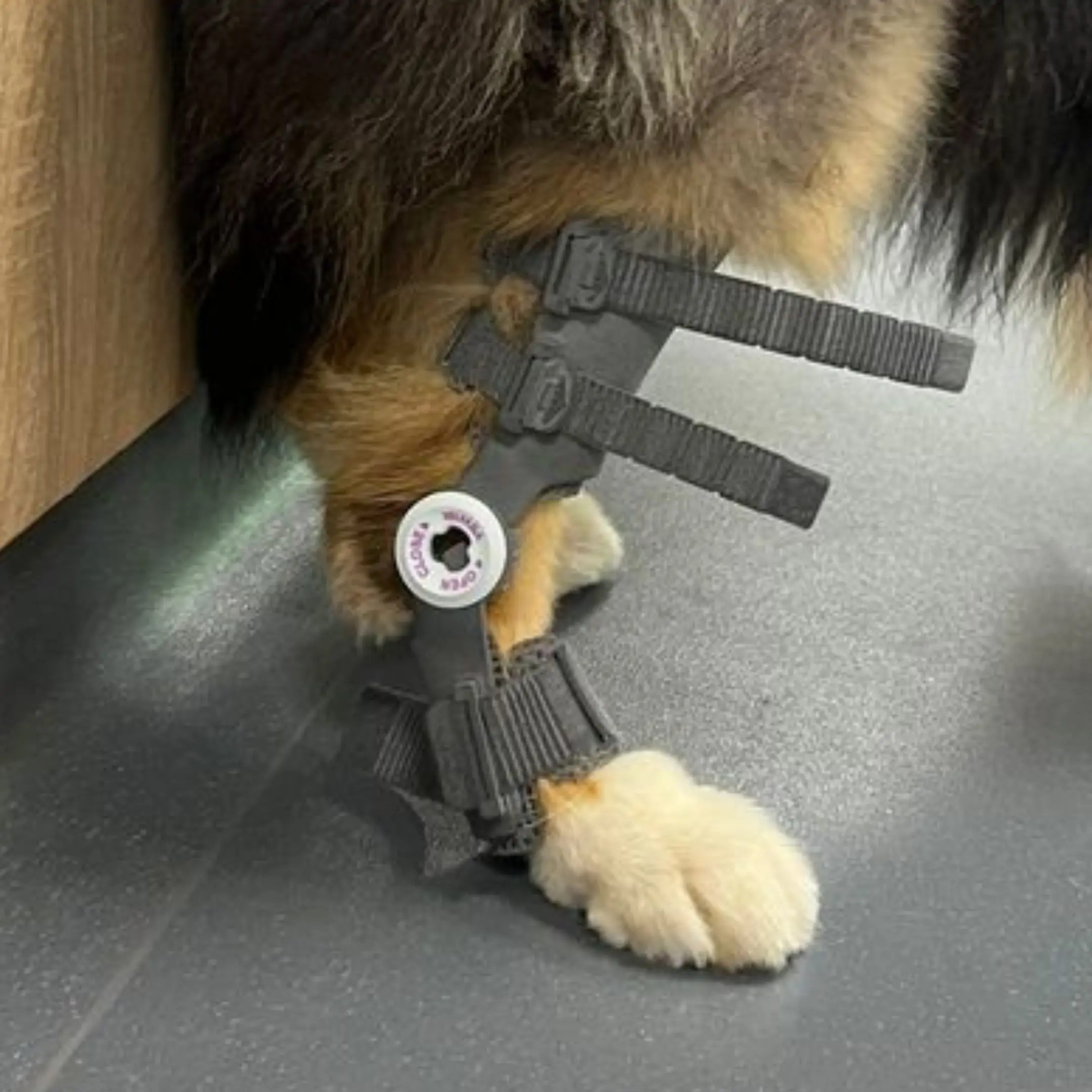
Dog hock support must work during real walks, not only while a patient stands in the fitting room. A dog hock orthotic has to remain aligned through repeated steps, changing surfaces, turns, and normal outdoor conditions. Safe daily walking support therefore depends on correct fitting, a gradual introduction, skin checks, supervision, and timely follow-up.
This practical guide explains how clinics and owners can manage dog hock support during ordinary leash walks. It complements the full clinical guide to the WIMBA hock brace, which covers diagnosis, candidacy, fitting, and evidence. A hock brace for dogs or tarsal orthosis should always be used according to the plan provided by the prescribing veterinarian or rehabilitation professional.
What Daily Walking Support Actually Means
Dog hock support for a normal walk has a different practical demand from a short exercise performed inside a clinic. The device must stay in the prescribed position while the dog starts, stops, turns, changes pace, and meets small variations in the ground. Regular use also places repeated demands on the straps, fasteners, inserts, hinges, and the skin beneath them.
A hock brace for dogs is still a medical device during an ordinary neighborhood walk. It does not become general sports equipment once the dog is comfortable wearing it. The clinic should define the permitted activity, walking duration, range of motion, surfaces, and any restrictions related to surgery, tendon injury, instability, osteoarthritis, or neurological disease.
The purpose is not to make every gait look identical to that of an unaffected dog. The aim is to provide the clinician-selected mechanical control while preserving acceptable comfort, skin condition, device position, and movement. If dog hock support changes the gait in an unexpected or worsening way, the plan needs review.
The Pre-Walk Fit Check
Before each session, the owner should repeat the application method demonstrated at the first fitting. WIMBA guidance requires the first donning at the provider’s facility so that position, hinge alignment, strap tension, clearance, retention, and gait can be checked.[1] This establishes the baseline for using dog hock support at home.
Before every walk, confirm that:
- The limb and skin are clean and dry, with no abrasion, sore, or swelling
- The device is clean, undamaged, and has every prescribed component in place
- The frame is not too high, too low, or rotated around the limb
- The hinges and motion-control components sit level with the hock joint
- Straps have even tension on both sides without trapped hair or pressure on the dewclaw
- No hard part of the frame contacts the skin during standing or walking
- The device stays in place during several controlled steps without twisting or sliding
A dog hock orthotic may need symmetrical strap adjustment after the dog stands, especially if it was applied while sitting or lying down. Owners should follow the number-of-clicks method and handling instructions taught by the provider. They should not add padding, wrap the limb, remove a prescribed strap, or change motion-control components unless the clinic has shown them exactly how and when to do so.
Building Wear Time Safely
There is no evidence-based promise that every dog will adapt to dog hock support within one, two, or three weeks. Pain, sensitivity, behavior, skin health, swelling, limb shape, diagnosis, and device configuration all affect acclimation. The written plan from the treating professional takes priority over a generic schedule.
The current WIMBA Tarsus Orthosis GO manual starts with up to 15 minutes of controlled leash walking, no more than three times daily. It then describes increases of 15 minutes every two days when the dog, skin, gait, and device position remain acceptable. The veterinarian or therapist may prescribe a different progression for the individual patient.[2]
This staged introduction applies to a tarsal orthosis used for daily walking support. It does not authorize continuous wear. A hock brace for dogs should not be worn 24 hours a day, overnight by default, or on an unattended dog. A longer walk should be added only when shorter sessions remain acceptable and the provider’s plan allows it.
Choosing Routes and Surfaces
During the introduction period, dog hock support should be evaluated on controlled leash walks that match the clinic’s instructions. A predictable, level route makes it easier to observe device position and gait. Stairs, steep slopes, deep sand, slippery surfaces, repetitive jumping, running, and off-leash play should not be added simply because the dog tolerated a short flat walk.
For later daily walking support, the route should still match the diagnosis and rehabilitation stage. Pavement is predictable but firm. Grass may be softer but can hide holes or become slippery when wet. Uneven ground can increase rotation and challenge balance. The correct choice is the surface on which the prescribed dog hock orthotic stays aligned and the dog moves safely within the permitted activity plan.
Watch the first steps after every change in terrain. Check whether the frame rotates, the paw catches, the dog shortens the stride, the limb swings outward, or the dog repeatedly stops. These observations do not diagnose the cause, but they help the provider decide whether dog hock support, route difficulty, wear time, or the wider treatment plan needs adjustment.
Skin and Device Checks After Every Walk
Remove the device after the prescribed session and inspect the entire contact area. Check the skin, coat, dewclaw region, pads, and spaces beneath the straps for persistent redness, rubbing, moisture, swelling, unusual warmth, hair loss, or tenderness. Also inspect the frame, hinges, inserts, fasteners, straps, and motion-control components before the next use of dog hock support.
Monitoring matters even when the initial fitting was successful. In a prospective study of 43 dogs using custom limb devices, 39 experienced at least one complication. Skin sores, mechanical problems, and repairs were reported, with many skin complications occurring during the first three months.[3] The study included different device types and does not predict the outcome of a specific patient, but it supports gradual acclimation and regular follow-up.
A brief mark that settles promptly may be interpreted differently from redness that persists, spreads, or becomes painful. The owner should use the threshold provided by the fitting clinic. When in doubt, remove the device, take a clear photograph of the skin and device position, and contact the provider before the next walk.
Rain Wet Grass and Cleaning
Normal outdoor use can expose dog hock support to wet grass, rain, mud, sand, snow, road salt, or other debris. Wet weather does not determine by itself whether the prescribed device should be used. The clinic’s plan does, and moisture trapped against the skin or left in inserts and straps can create a separate problem. Check the dog’s skin and dry the limb after the walk.
WIMBA guidance instructs owners to clean the orthosis after contact with grass, soil, mud, sand, snow, salt water, or chlorine. Hand-clean it with lukewarm water and mild soap, remove excess water, and allow it to air-dry. Do not use a washing machine, hair dryer, heater, or direct structural modification.[2] Reapply the tarsal orthosis only when the device and limb are ready according to the provider’s instructions.
When to Stop and Contact the Provider
Remove dog hock support and contact the fitting clinic before the next session if the device slips, twists, repeatedly catches the dewclaw, or brings a hard component into contact with the limb. The same applies if a part is cracked, loose, missing, deformed, or no longer operates as demonstrated.
- Redness that does not settle promptly after removal
- An abrasion, sore, blister, swelling, discharge, or unusual heat
- New or worsening lameness, pain, anxiety, or reluctance to move
- A shortened stride, repeated paw catching, or a new outward swing of the limb
- A noticeable change in limb size, postoperative swelling, or device retention
- Any damage to the frame, strap, fastener, insert, hinge, or motion-control component
Do not cut, drill, heat, bend, grind, or reshape the frame at home. Do not exchange motion-control components unless the prescribing professional directs the change. Altering the permitted range changes the clinical function of the device.
Why Fit Can Change Over Time
A well-fitted dog hock orthotic may need reassessment as the patient changes. Postoperative swelling can decrease, muscle mass can increase or fall, body weight can change, hair can grow, and rehabilitation can alter stance and loading. Normal wear can also affect straps, inserts, and fasteners. These changes may alter how dog hock support sits during walking.
There is no universal recheck interval for every dog. The clinic should schedule reviews according to diagnosis, recovery stage, skin risk, device configuration, and treatment goal. Owners can help by recording walking duration, surface, skin findings, and behavior, and by taking a short gait video from the same angles when the provider requests it.
Dog Hock Support Within the Mobility Plan
Dog hock support is usually one part of a wider veterinary plan. A dog may also need prescribed activity limits, rehabilitation, pain management, weight management, surgery, environmental changes, or treatment for another joint or neurological condition. A hock brace for dogs cannot confirm a diagnosis or prove that an injured structure is fully unloaded.
A biomechanical study in six dogs found that tarsal immobilization reduced but did not eliminate strain in the common calcaneal tendon.[4] This supports a cautious interpretation of a tarsal orthosis. The device can influence motion while it is worn, but healing and permitted activity must be judged by the treating team.
The full dog hock brace guide explains candidacy and the differences between WIMBA GO and PRO pathways. Current WIMBA tarsal orthotics are supplied through veterinary professionals, so dog hock support remains connected to assessment, fitting, owner instruction, and follow-up.[5]
A Simple Routine for Every Prescribed Walk
- Before application: check the skin, limb, and every device component.
- During application: position the hinges at joint level and tighten both sides evenly as demonstrated.
- At the first steps: confirm that the frame stays aligned and does not twist, slide, or contact the skin.
- During the walk: follow the prescribed time, surface, pace, and activity limits.
- After removal: inspect the skin, dry the limb, clean the device when needed, and record anything that changed.
This routine makes dog hock support easier to evaluate from one session to the next. Consistency also gives the provider better information if the dog needs a fitting change, a slower progression, or reassessment of the clinical plan.
Get Professional Hock Support
If a dog struggles with walking because of diagnosed hock instability, osteoarthritis, selected tendon injury, or a rehabilitation need, a WIMBA Provider can assess whether a custom device is appropriate. Veterinary professionals can also submit an uncertain case for review before ordering dog hock support.
Frequently Asked Questions About Dog Hock Support
Can dog hock support be used on every walk?
That depends on the diagnosis and prescription. Some dogs use it during every planned walk, while others use it only for selected sessions or a defined rehabilitation stage. The provider should specify when daily walking support is required and when the device should remain off.
How should wear time be introduced?
WIMBA Tarsus Orthosis GO guidance starts with up to 15 minutes of controlled leash walking, no more than three times daily, followed by 15-minute increases every two days when checks remain acceptable. The treating veterinarian or therapist may change this schedule for the individual dog.
Can a dog wear the device all day or overnight?
No, not by default. WIMBA Tarsus Orthosis GO is not intended for 24-hour use, and a dog must not be left unattended while wearing it. Follow the prescribed schedule for the hock brace for dogs and remove it for skin inspection after each session.
What should I do after rain or wet grass?
Remove the tarsal orthosis after the prescribed walk, inspect and dry the skin, and clean the device when needed. Use lukewarm water and mild soap, remove excess water, and allow it to air-dry. Do not use a washing machine, hair dryer, or heater.
Which skin changes require a provider check?
Remove the device and contact the provider for persistent redness, abrasion, sores, blisters, swelling, discharge, unusual warmth, or pain. Do not continue using a dog hock orthotic over damaged skin unless the treating professional has given specific instructions.
Can owners tighten straps or change motion-control parts?
Owners can use the strap method demonstrated by the provider and may need to retighten evenly after the dog stands. They should not change the prescribed range of motion, remove required components, add padding, or modify the frame without professional direction.
How often should fit be rechecked?
There is no universal interval. Rechecks depend on the diagnosis, recovery stage, swelling, skin risk, growth or weight change, device wear, and treatment goal. Arrange an earlier review if the device slips, rubs, becomes damaged, or the dog’s gait or tolerance changes.
Medical Disclaimer: This article is intended for general educational purposes only and does not replace veterinary examination, diagnosis, or treatment. Do not begin, extend, or change a prescribed wear schedule or range of motion without professional direction. Seek prompt veterinary care if a dog cannot bear weight, develops sudden or severe lameness, has an open wound or major swelling, or shows progressive weakness or poor coordination.
Scientific and Product References
- WIMBA Knowledge Base. WIMBA Tarsus Orthosis Go: First Donning. Updated May 26, 2026. Fitting guidance
- WIMBA Knowledge Base. WIMBA Tarsus Orthosis Go: User Manual. Updated May 26, 2026. Wear, care, and safety guidance
- Rosen S, Duerr FM, Elam LH. Prospective evaluation of complications associated with orthosis and prosthesis use in canine patients. Front Vet Sci. 2022, 9, 892662. doi:10.3389/fvets.2022.892662
- Lister SA, Renberg WC, Roush JK. Efficacy of immobilization of the tarsal joint to alleviate strain on the common calcaneal tendon in dogs. Am J Vet Res. 2009, 70(1), 134–140. doi:10.2460/ajvr.70.1.134
- WIMBA. WIMBA Tarsal Orthotics GO. Current product, indications, ordering, and support information. View current product information